"Support for sustainable decision-making and arrangements that preserve dignity for everyone during and after life" project is conducting literature surveys on decision-making in a variety of fields. The findings and suggestions gained from this literature survey will be presented in easy-to-understand columns by researchers.
This time, we have a column about "choice" written by a researcher at Kyoto University.
◇Key words: choice, freedom, personal responsibility, nudge, libertarian paternalism
summary
We are faced with many choices every day. In these situations, we tend to think that "the more choices we have, the better" and "we can choose the best things for ourselves." However, the authors of recent best-selling books about "choice" have questioned this way of thinking.
We also have the idea of "personal responsibility," that is, that we should take responsibility for the choices we make freely, but in light of new facts about choice, this idea of "responsibility" may also need to be reconsidered.
And in order for us to make better choices, we need to create proactive environments in which people can make better choices, rather than simply presenting them with more options.
Point 1. Our misunderstanding about choices: "The Science of Choice"
We make many choices every day, such as upgrading our smartphone models, choosing what to have for dinner, or choosing a program on a video streaming service. And we base these "choices" on certain assumptions.
First of all, we tend to think that "the more choices, the better." Rather than being limited to just two choices, udon or soba, we are happier to have three options, udon, soba, or curry, and the same goes for other things.
We also believe that we are best able to make decisions about ourselves. In the same vein, this makes sense, since we know best about what to have for dinner, how we feel, our health, and so on.
However, in recent years, this idea of "choice" has been forced to be significantly reconsidered. First, I would like to introduce a book called "The Science of Choice" (Sheena Iyengar, Bungeishunju, 2010). This book uses various experiments to explain how human choices deviate from the intuition mentioned above.
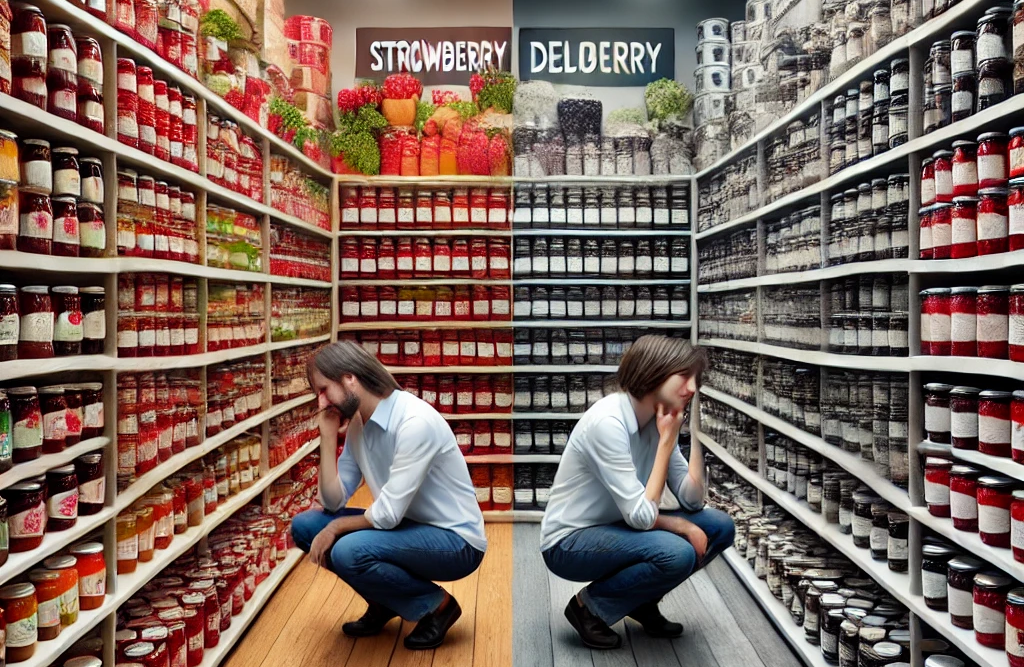
This book introduces various experiments, but the most famous of them is the "Jam Experiment" conducted by the author Iyengar himself. The author set up a jam tasting corner in a corner of a department store and asked customers to sample jams to see if tasting would lead to actual purchase of jam. The key to this experiment was that the types of jam displayed in the tasting corner were changed every few hours between 24 types and 6 types. From our normal perspective, if we can choose from a wide range of options, we are more likely to find one that suits our tastes, so naturally choosing from 24 types would seem to lead to a purchase.
However, the results were the opposite: 30 percent of customers who visited the tasting booth with six varieties of jam purchased something, whereas only 3 percent of customers who visited the booth with 24 varieties actually purchased something. As you can see, too many options can sometimes overwhelm us, leading us away from the best choices or preventing us from making any choices at all.
Our choices are also heavily influenced by recent events, the culture we grew up in, how busy we are at work, etc. Our belief that if we are given a choice, we will make a wise and rational choice is sometimes a delusion.
Point 2. Rethinking the concept of "personal responsibility": "The Myth of Choice"
Taking the new understanding of choice presented in The Science of Choice a step further is The Myth of Choice (Kent Greenfield, Kinokuniya Shoten, 2012). Greenfield acknowledges that, as Iyengar has shown, having a wealth of options does not necessarily lead to good outcomes, and that our choices are subject to various biases, and proposes a rethinking of the idea of personal responsibility.
In our society, especially in America where the author lives, the responsibility for each choice is as great as the respect for each individual's choice. While one has the freedom not to purchase life insurance, if one does so, one is responsible for one's own actions, meaning that one cannot receive public assistance, if one becomes ill or injured. Greenfield argues that this notion of personal responsibility arises from a mistaken idea about choice, that is, that "if we are given the choice, we can make the best choice for ourselves." He then suggests that the idea of personal responsibility should not be considered as something that is complete within the individual, but should be interpreted in relation to the people around us and society as a whole.
For example, if someone dies as a result of not wearing a helmet and has an accident, the traditional view of choice would be that the person freely chose not to wear a helmet, and that any resulting injury or death is his responsibility, not something that other people should intervene in. In contrast, the author argues that if someone dies because they neglected to wear a helmet, they have incurred costs for passersby, their family, and their workplace, but have not paid those costs, that is, they have not fulfilled their "personal responsibility." He then reinterprets "personal responsibility" as a way of behaving that includes these costs to those around us.
If we rethink the concept of personal responsibility in this way, we can go from thinking, "Whether or not to wear a seat belt is your own responsibility," to thinking, "Making wearing seat belts and taking out insurance mandatory is necessary to ensure that people fulfill their personal responsibility."
In order to enable each individual to fulfill their own personal responsibility in the above sense and make rational choices that are less biased, Greenfield proposes public policies based on "nudges," which he will discuss later.
Point 3. Making better choices with "nudges": "Practical Behavioral Economics: The Complete Edition"
The word "nudge" was invented and made into a buzzword by the Nobel Prize-winning book "Practical Behavioral Economics" (Richard Thaler and Cass Sunstein, Nikkei BP, 2022).
Thaler and Sunstein propose a method to enable individuals to make better choices through the concept of "nudge." A "nudge" is a mechanism that uses knowledge from behavioral economics to encourage people to make more desirable choices, rather than forcing or ordering them.
For example, many people tend to put off financial planning for their retirement, but if a system were introduced whereby companies automatically enroll employees in their pension plans (with the option for individuals to opt out), more people would be able to secure money for their retirement. This is one example of a successful use of "nudges" to guide choices in a rational direction.
Nudges are also used in a variety of fields, such as by placing vegetables and fruits in easy-to-reach locations in cafeterias to encourage healthy eating, and by using social proof such as "XX percent of people pay their taxes on time" to encourage people to pay their taxes.
What is important here is that "nudges" do not take away people's freedom of choice. For example, in cases where having too many options makes it difficult to choose, as in the jam experiment, devising a way to present appropriate options can help people make better decisions. This is different from the conventional idea that "more options = freedom and good," and is a new approach that ensures freedom while leading to better decision-making.
summary
As recent bestsellers have shown, our conventional ideas about "choice" are undergoing a major rethink. Simply increasing the number of options is not the answer, and individual choices are not always rational. Therefore, the concept of personal responsibility may need to be reconsidered to take into account the impact on society as a whole.
And in order for us to make better choices, it is important not to simply provide information, but to create an environment that acts like a "nudge." In the future, it will become increasingly necessary for society as a whole to consider ways to encourage better decisions while respecting the freedom of individual choice.
Regarding the issue of "de-cluttering," which is the subject of this project, many people tend to put off making decisions, or do not receive appropriate support under the pretext of "personal responsibility." In addition, when it comes to the choices of the elderly, there are cases where they have cognitive problems, so it is necessary to devise a framework to support better decision-making.