preface
In recent years, the idea of "neurodiversity" has been gaining attention. This is a perspective that considers developmental characteristics such as autism spectrum disorder (ASD) and attention-deficit hyperactivity disorder (ADHD) as individual diversity rather than disorders. This way of thinking provides clues for understanding the characteristics of people who are active in various fields from a new perspective.
This time, we will be bringing you a "free talk by researchers" (3 parts in total) about the philosopher Ludwig Wittgenstein, who is thought to have had developmental characteristics (*1). Please enjoy the talks of researchers who are a little bit nerdy and laid back.
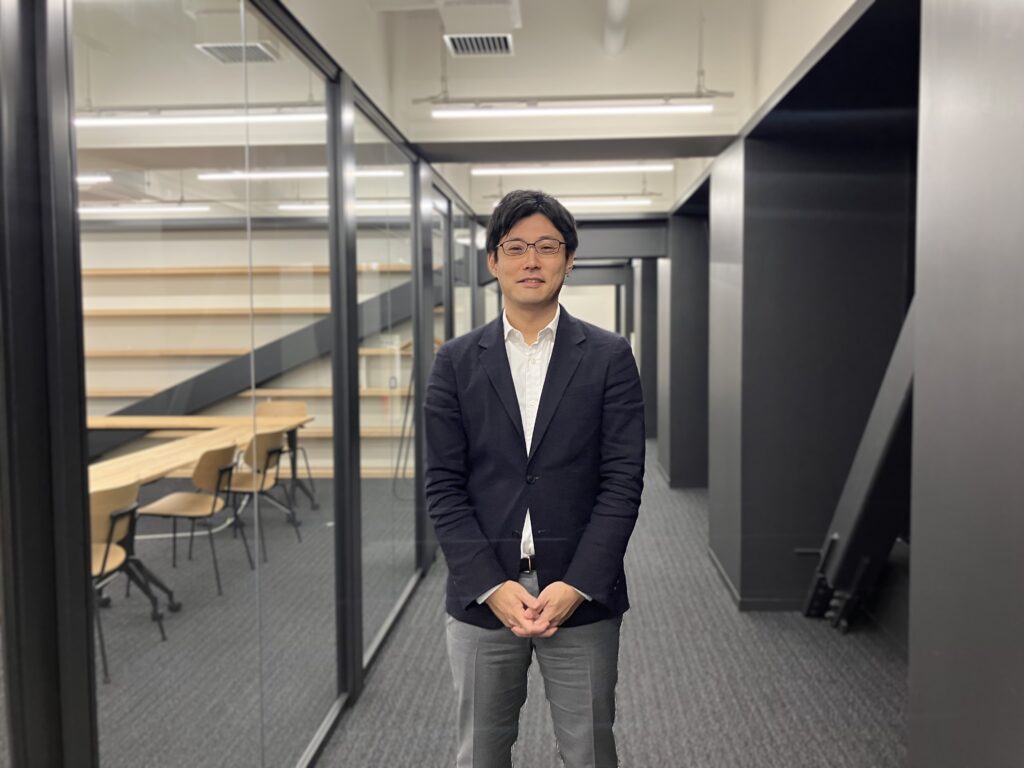
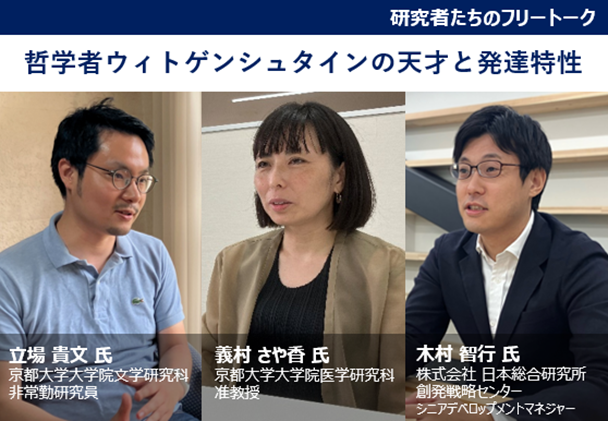
The talk participants were Mr. Tachiba (*2), a researcher specializing in Wittgenstein at the Graduate School of Letters, Kyoto University; Mr. Yoshimura (*3), an associate professor at the Graduate School of Medicine, Kyoto University; and Mr. Kimura (*3), a researcher specializing in neurodiversity and innovation at the Japan Research Institute.
(*1) References
Ishizaka, Yoshiki (2003) On the cognitive form of Asperger syndrome: Based on Wittgenstein's writings: Part 1: Did Wittgenstein have Asperger syndrome? Child and Adolescent Psychiatry and Related Fields, 44, 231-251.
Fitzgerald, M. (2000). Did Ludwig Wittgenstein have Asperger's syndrome? European Child & Adolescent Psychiatry, 9: 61-65.
(*2) "Support for sustainable decision-making and arrangements that preserve dignity for everyone during and after lifeProject members of
(*3) "Supporting people with developmental disabilities to demonstrate their abilities in the workplaceProject representative of
Part 1: Developmental characteristics seen from Wittgenstein's historical episodes
Wittgenstein is a 20th century philosopher who is still attracting attention today for fundamentally rethinking the question, "What is language, anyway?" and turning philosophical thinking upside down twice. In the first episode, we will deliver a free talk on the theme of developmental characteristics seen from Wittgenstein's historical episodes.
Early life and family environment
(Position) First, let me introduce Wittgenstein's upbringing. Wittgenstein was born to his father, Karl Wittgenstein, who made a fortune in the steel industry in Vienna. His father, Karl, was one of the wealthiest men in the world and is said to have been very authoritarian. He was also interested in art and grew up in a family that would invite painters and musicians to their home.
It is also said that many people in the family had mental health issues. I think the reason for this was a special environment, such as the personality of the father, Karl.
(Yoshimura) I just looked up your father's Wikipedia page, and it seems that he was restless as a child. I think he may have had a developmental disorder. He was quite energetic and active, and his emotions were quite intense. There is a story that among successful businessmen who have the ability to push forward with whatever idea comes to their mind, those with strong ADHD traits tend to have strong ADHD traits.
(Kimura) It is true that many startup founders and owner-managers are said to have ADHD traits. They stand out for having the energy and drive to get others involved.
(Position) Perhaps the developmental characteristics common to both Karl and Ludwig led to their success as businessmen and philosophers, respectively.
Wittgenstein's changing interests
(Position) Later, Wittgenstein became interested in engineering and went on to a school similar to what is now known as a technical high school in Japan. He studied aeronautical engineering, but while he was thoroughly involved in engineering, he also learned mathematics and became interested in logic and philosophy.
(Yoshimura) I feel that the way knowledge spreads is something in common with ASD. The diagnostic criteria say that the person has "restricted interests," but when they delve deeper into those interests, they inevitably delve deeper into the surrounding areas. I felt that this was very typical.
(Kimura) It's common to hear people say, "As you study, you start to become interested in other things," but is this different?
(Yoshimura) I was a little surprised to see how they connected the two. At first glance, there is no connection, but when you listen carefully, you can see that they have their own logic behind it. In the case of typically developing children, the curiosity seems a little lighter.
Developmental characteristics seen in the role of educator
(Position) Let's go back to the story of Wittgenstein's life. After that, Wittgenstein served in World War I, and deepened his philosophical thoughts while working as a soldier. It is said that during this period he conceived the contents of his later major work, Tractatus Logico-Philosophicus. After the war, he became an elementary school teacher. In his classes, he taught very practical and investigative lessons, such as making skeletal specimens using real cat bones for his students. However, he left school due to corporal punishment. Incidentally, during this period, he also published a dictionary for elementary school students. Unlike ordinary dictionaries, this one included words that were frequently used in actual writing.
(Yoshimura) Corporal punishment is a problem, but apart from that, you are doing an extremely good job as an educator.
(Position) There is no doubt that he was a passionate person.
(Yoshimura) I think the way he rushes ahead will be different depending on whether he's interested or not, but when he decides on something, he takes very firm and steady action.
(Position) He is a man of action. And what's more, he goes above and beyond when it comes to doing things.
(Kimura) One thing I noticed is that the dictionary he created emphasized ease of use. This seems to contradict the commonly held belief that ASD people have a "lack of empathy." How should we interpret this?
(Position) Yes. It may be related to the fact that Wittgenstein himself did not receive a typical elementary school education.
(Yoshimura) Perhaps it was a good thing that he was not influenced by traditional educational concepts. He may have had difficulties in situations that required emotional interaction, but he may have been effective in situations where emotions were not involved, such as the systematization and transmission of knowledge.
(Kimura) So the matching with interests and abilities worked well in the form of a dictionary for elementary school students. Or maybe he simply had a very high ability to recognize patterns in text. It's interesting that he seems to embody today's generative AI.
(Position) That seems possible. It is possible that he observed the children's work, identified the most frequently used words, and arranged them in order.
(Yoshimura) I once again felt that matching your interests with the environment is extremely important.
(2nd timeContinued)