Starting with this issue, we will introduce some of the current state of junior high school students in Japan as revealed by the results of the ISRD4 Japan Survey. The subjects of the analysis were first to third year students at five junior high schools in the Kinki region, with a total of 1,820 valid responses. By gender, there were 927 boys, 896 girls, and 22 students who answered that neither applied to them (*1). This time, we will focus on "home/school" and "delinquent experiences" from the students' perspective.
(*1) Details of ISRD4 will be published in a report in the fall of 2025.
Impressions of home and school
What are students' impressions of their relationships with their parents at home and their classes at school?
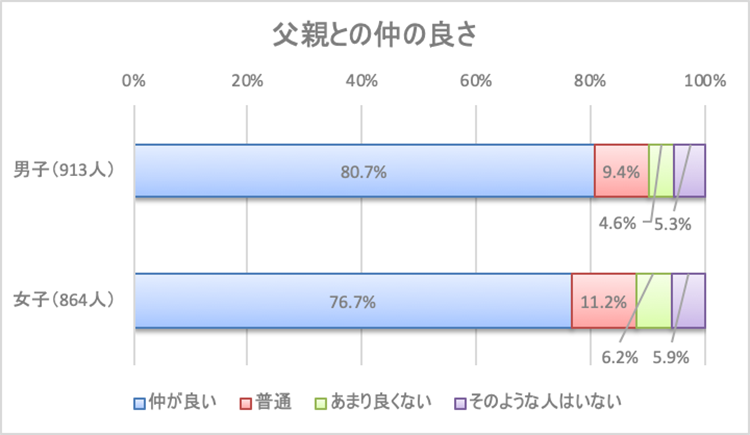
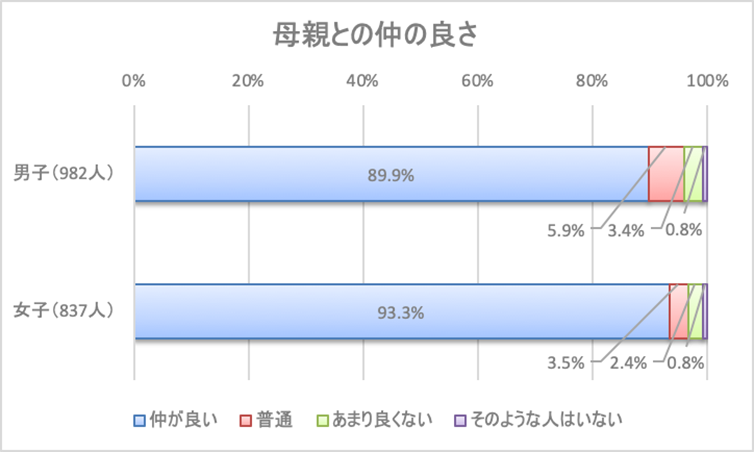
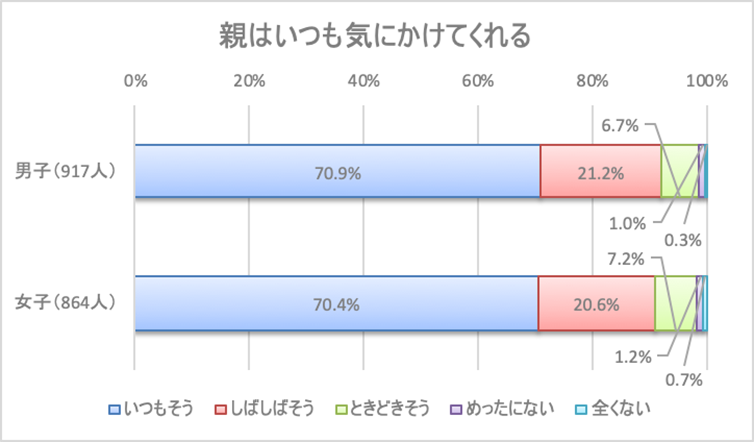
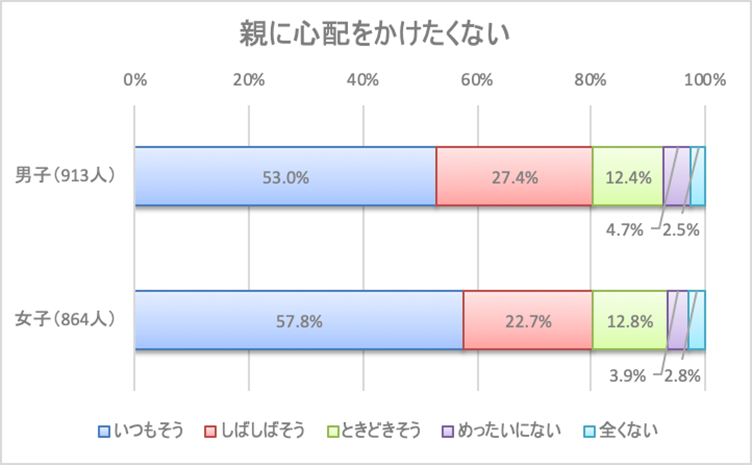
This survey revealed that many students responded that they have a good relationship with their parents, and that they are aware of the consideration and care their parents show them. There were also gender differences in the level of their relationship with their parents, with boys reporting a closer relationship with their fathers and girls reporting a closer relationship with their mothers.
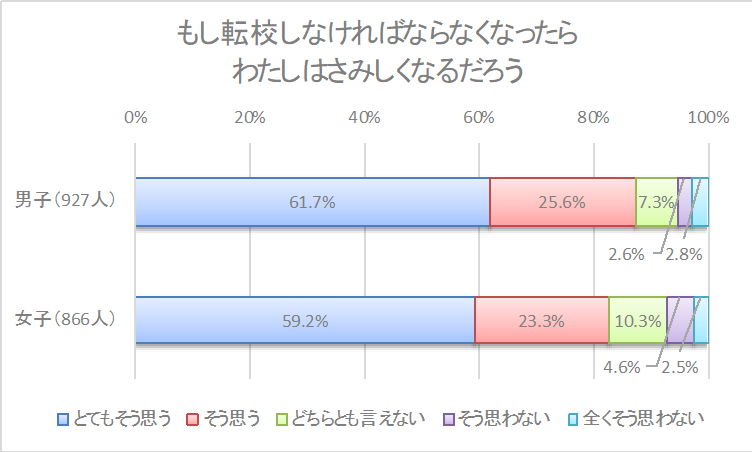
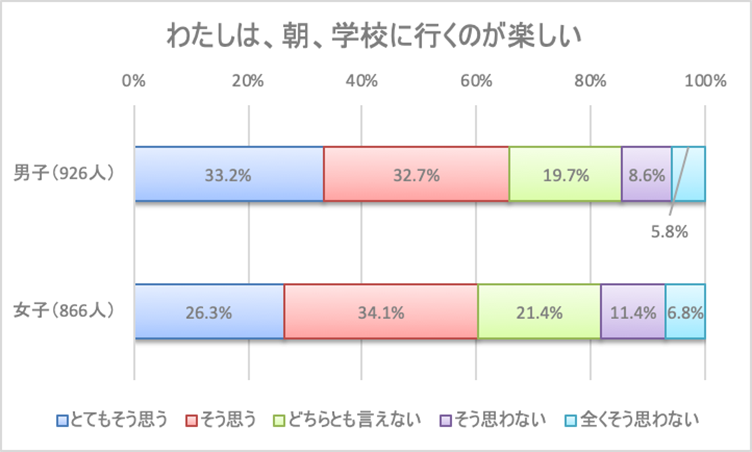
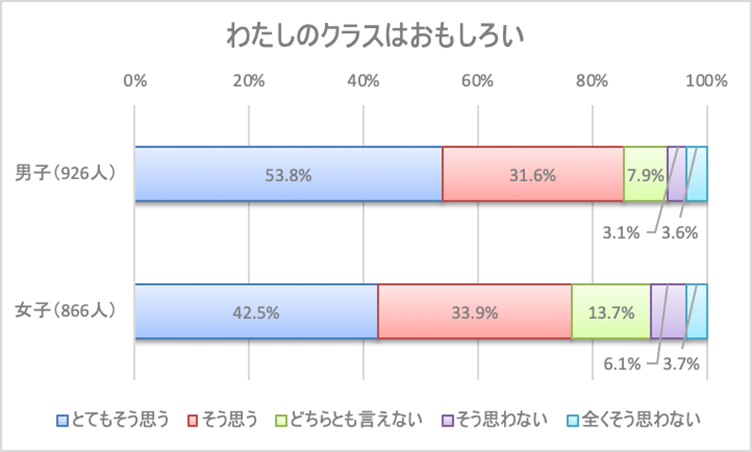
Next, we looked at impressions of school and class. Here too, the results showed that overall, many students felt attached to their class and enjoyed school life. We also found that in all three questions, boys had more positive impressions of school and class than girls.
delinquent experiences
Next, let's look at delinquent behavior, one of the core components of the ISRD. ISRD 4 asks whether participants have ever experienced 14 types of delinquent behavior in their lifetime: graffiti, vandalism, shoplifting, burglary, motorcycle/car theft, extortion/robbery, carrying a deadly weapon, group fighting, assault with a deadly weapon, drug trafficking, spreading private photos or videos of others, discriminatory comments on social media, online fraud, and hacking. If they have, they are also asked to state the number of times in the past year. Of these, the most common behavior was shoplifting, with 62 students (3.5%) reporting that they had experienced it at least once in their lifetime. Furthermore, it was shown that boys generally had a higher rate of experience than girls across all categories.
The graph below shows the number of types of delinquent acts experienced in a lifetime by gender. The majority of both men and women answered "0 types." Only 103 boys (11.2%) and 59 girls (6.8%) answered that they had experienced one or more types, indicating that this is a low number for both men and women.
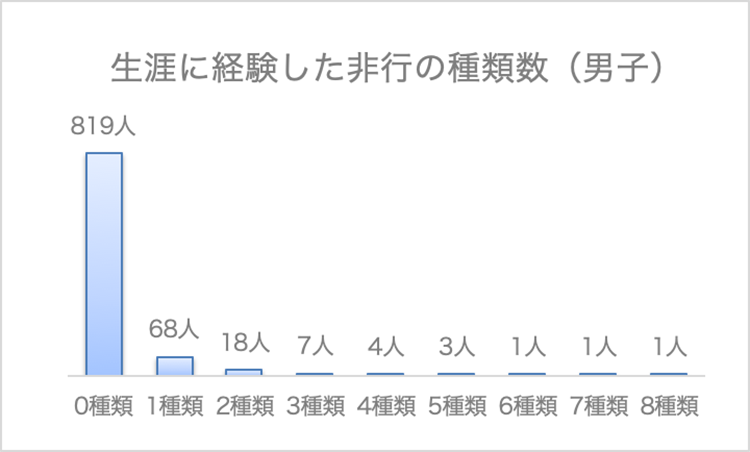
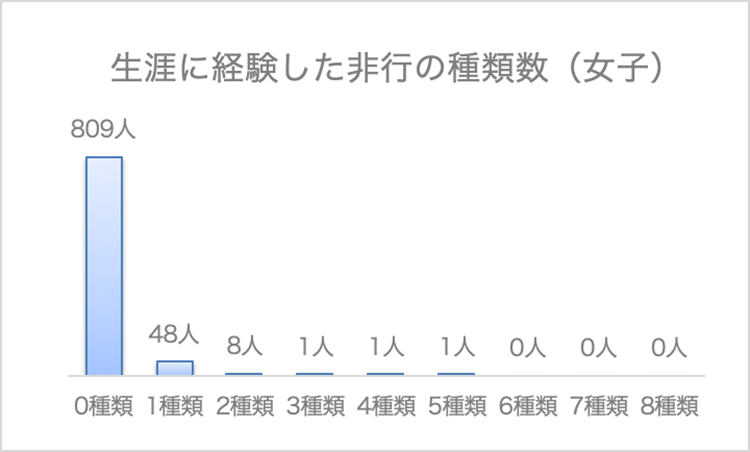
It has long been shown that the number of juvenile delinquencies in Japan is lower than in Western countries.(*2) This survey also showed that the number of juveniles who have experienced each type of delinquency is low. It also showed that boys are more likely to have experienced delinquency than girls, which is consistent with international trends in crime and delinquency.
What lies behind this kind of delinquent behavior? There are several theories about the causes of delinquent behavior, but one of the most representative is the "Bond Theory" (Hirschi 1969). This theory explains that when a child commits a delinquent act, social ties (= bonds) with parents, friends, etc. keep the child from committing delinquent behavior, such as "If I do something bad and get caught by the police, my parents might be sad," or "If rumors spread that I've been taken into custody, my important friends might distance themselves from me." This means that students with fewer such connections are more likely to turn to delinquent behavior.
Now, let's look at the correlation between the strength of attachment to home and school (*3) and delinquent experiences (*4) found in this survey.
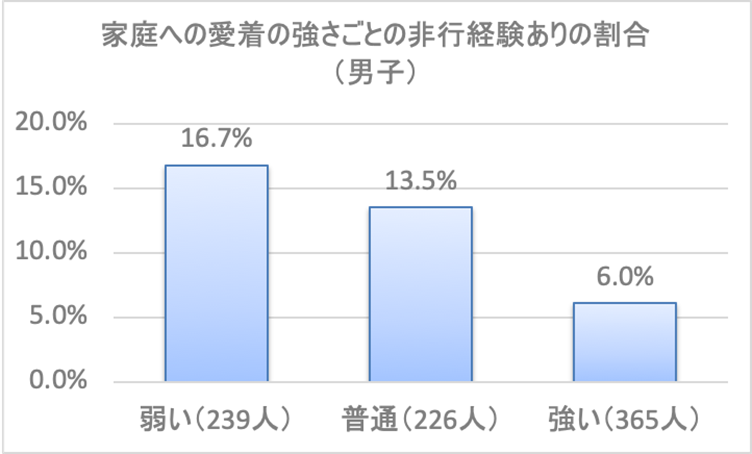
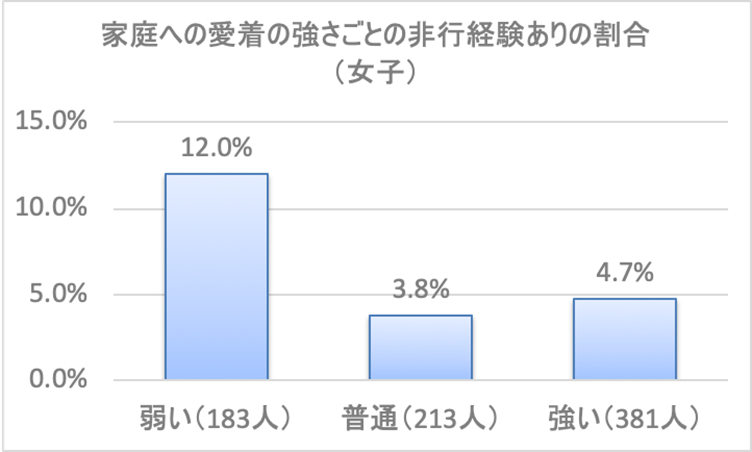
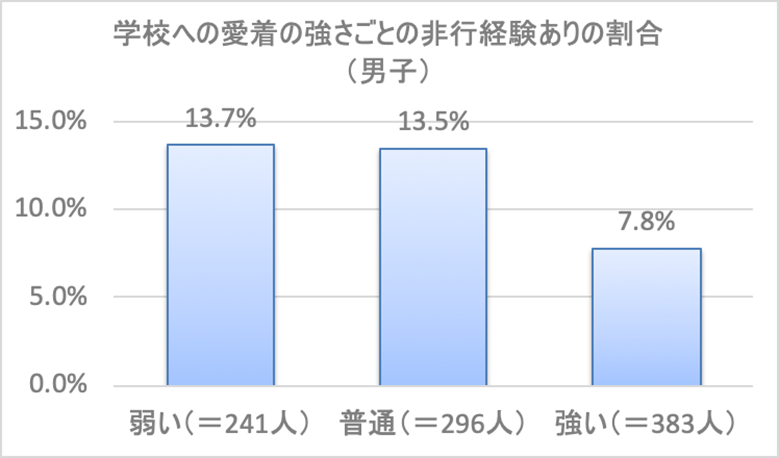
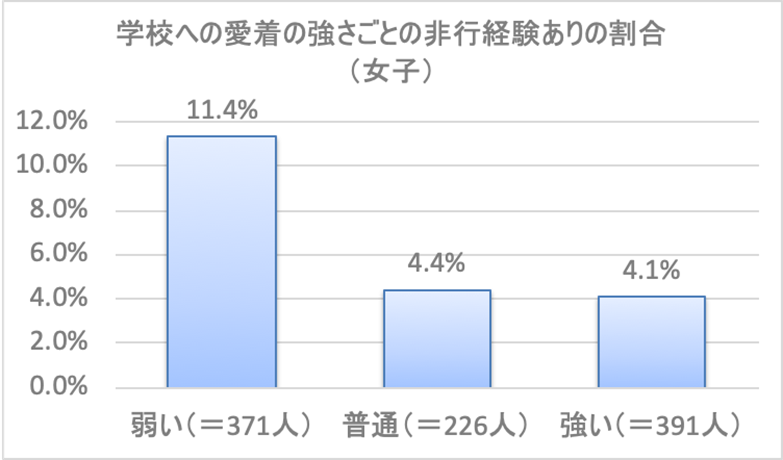
This survey confirmed that the relationship between attachment to home and school and delinquent behavior was observed in both boys and girls, and that the trend was similar to the findings of Bond theory.
(*2) Ministry of Justice, 2005, "2005 White Paper on Crime" Part 4, Chapter 6, Section 5
(*3) Attachment to family was measured by adding up four items (each item was scored from 1 to 5): "I get along well with my father," "I get along well with my mother," "My parents always look out for me," and "I don't want to worry my parents," and then reducing them to three categories in order of their scores. Similarly, attachment to school was measured by adding up three items (same as above): "I would be lonely if I had to transfer schools," "I enjoy going to school in the morning," and "My class is interesting," and then reducing them to three categories in order of their scores.
(*4) If a person has experienced at least one of the 14 delinquent acts in their lifetime, they were considered to have had a delinquent experience.
References
Hirschi, Travis W., 1969, Causes of Delinquency, University of California press. (=1995, Supervised translation by Morita Yoji and Shimizu Shinji, Causes of Delinquency: In Search of Connections Between Family, School, and Society, Bunka Shobo Hakubunsha)
| NEXT In our next issue, we will focus on the "abuse and adversity experiences" of today's junior high school students as revealed by the ISRD4 Japan survey. |