Enzymes play an important role in the survival of life, such as breaking down food in the body and converting nutrients into energy. Professor Song Ha-kyung-seong of the Graduate School of Agriculture, Kyoto University, has succeeded in observing the shape of an enzyme called a "conductive enzyme." In the SMBC Kyoto University Studio project,CO that utilizes enzymes and can be used by anyone, anywhere2Development and implementation of resource recycling technologyWe spoke to him about his research so far and the social issues he hopes to solve through the project.
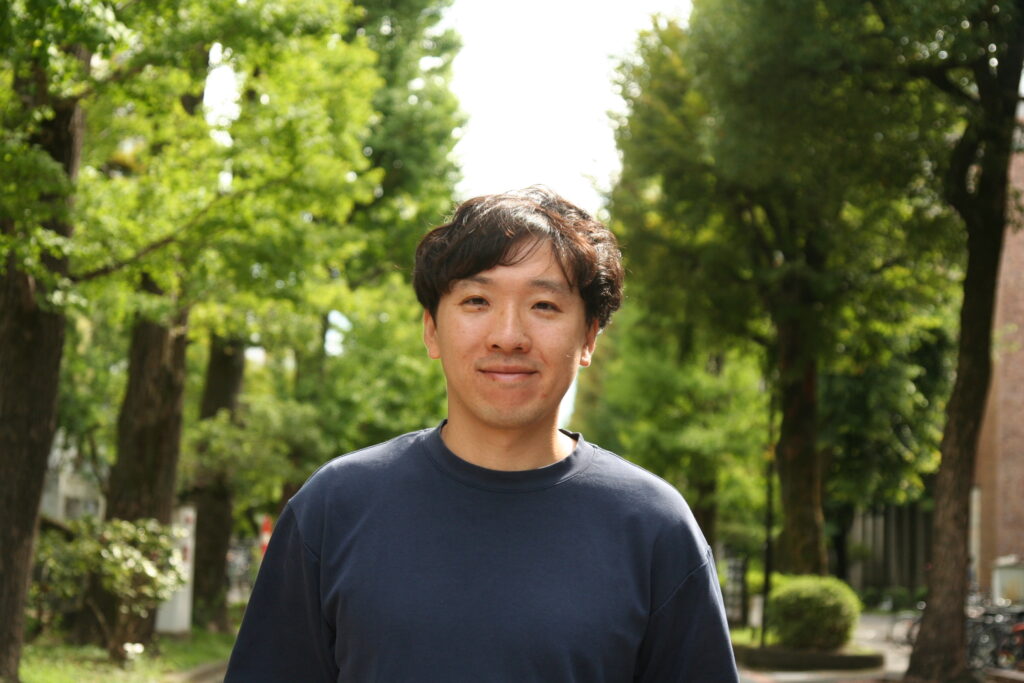
His specialty is bioelectrochemistry, and he aims to electrochemically elucidate the essence of biological functions (respiration, metabolism, photosynthesis) and apply them to biotechnology.
Using enzymes2to turn it into a bioresource
When you eat rice, enzymes break it down and metabolize it, generating energy to keep your body moving. Enzymes are so powerful that a cup of rice (about 150 grams) is converted into the energy of about 96 AA alkaline batteries (*1).
As a rule, electricity does not flow through the proteins that make up enzymes, but in rare cases, electricity does. Only about 30 types of these enzymes have been identified in the world and are called "conductive enzymes." My research aims to elucidate the mechanisms of conductive enzymes and to utilize them as resources.
When conductive enzymes are used, CO2can be converted into formic acid, which has the potential for effective use,2In the research we have been doing so far, we have been working on the2In this project, we confirmed that the enzymes function properly in medium concentrations (10% or more) and extremely low concentrations (atmospheric levels) of CO.2However, I would like to develop technology that allows enzymes to function, and then use that technology to create small devices and conduct actual tests. Ultimately, I would like to share a medium- to long-term vision with industry, government, and academia, and conduct large-scale demonstration tests together.
Even now, CO is released into the atmosphere2Although there are technologies to reduce CO2, there are some issues.2One method is to react CO with hydrogen to produce methane, which can then be used as fuel, but hydrogen can be explosive, and the hydrogen and CO2To convert this into methane, high temperature and pressure conditions are required, so it can only be implemented in facilities with strict safety controls.
There is also the option of burying it underground, but the biggest problem with this technology is that it is not possible to evaluate its safety. Although efforts are being made to minimize the risks as much as possible, there is a possibility that, like nuclear power plants, irreversible damage may be occurring.
Enzymes work at room temperature and pressure in a neutral environment, so they are not dangerous. I think the amazing thing about enzymes is that they work efficiently even at room temperature (25-37°C).
(*1) Reference:It's like a living thing! A new battery that drinks juice?” Journal of the Institute of Electrical Engineers of Japan, Vol. 131, No. 7, 2011
The world's first capture of the shape of a conductive enzyme
Conductive enzymes are very simple intermediaries that convert the energy contained in substances into electricity, or conversely, use electricity to efficiently transform substances. I don't think there are any other energy conversion devices that are as simple as this.
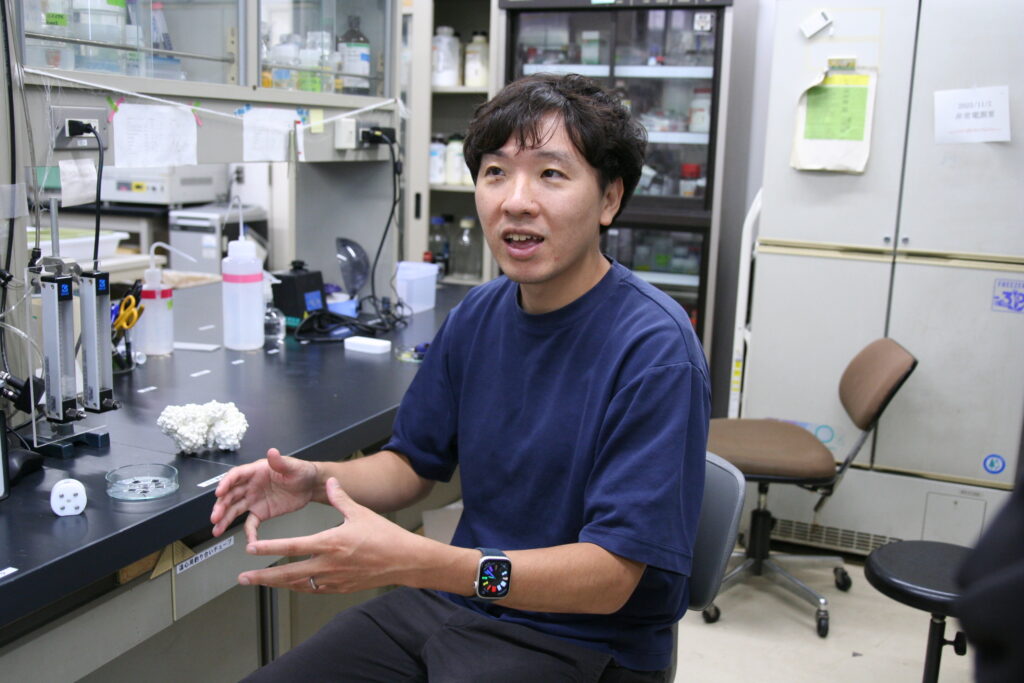
I have been conducting research on outstanding conductive enzymes since my student days. I wanted to see the shape of these enzymes, but there had been no successful examples anywhere in the world. However, after I took up my post at Kyoto University in 2021, I asked Professor Keiichi Namba of Osaka University to collaborate on research, and when we tried a method of observing them by irradiating them with an electron beam, we were able to see them. If we know the shape, we can change it to any shape we like, which allows us to improve it and expand its functions. It was a major breakthrough.
In order to make electricity flow through a conductive enzyme, it is not enough to simply attach the enzyme to an electrode; it must be attached in a certain direction for it to function. Understanding the shape and structure made it easier to find a good match with the electrode, and the ease with which electricity flows doubled or tripled. The basic knowledge we gained has been useful in this project.
Developing decarbonization technology that can be used by anyone, anywhere
I have a two-year-old child, and in the summer, he can't go out without a mini fan attached to his stroller. Compared to when I was a child, the heat these days feels life-threatening. I want to tackle the social issue of global warming as a researcher. Having worked for a company, I want to go beyond basic research and contribute to solutions.
Up until now, energy balance has not been considered as a whole. It takes hundreds of millions of years for crude oil to become crude oil, but that time has not been taken into consideration. That's why it was cheap. However, when using crude oil, we should also consider the time it takes for that crude oil to be regenerated. In the future, I think there will be a great demand for a total circulation system using enzymes.
If this project is successful, it will become a decarbonization technology that can be used anywhere and by anyone, and it will also produce formic acid and other useful substances that utilize formic acid. Even if I work on it alone for three years, it will be difficult to bring about major changes in society, but I feel that there is a lot that can be done if it becomes mandatory like plastic bags, or if companies and others get involved and the idea that "this kind of society is important" becomes widespread. In order to get many people involved, we need to consider whether the benefits of the investment can be shared. I would like to create an ecosystem for implementing enzyme-based technology in society, while also borrowing the knowledge of the Japan Research Institute, my project counterpart.