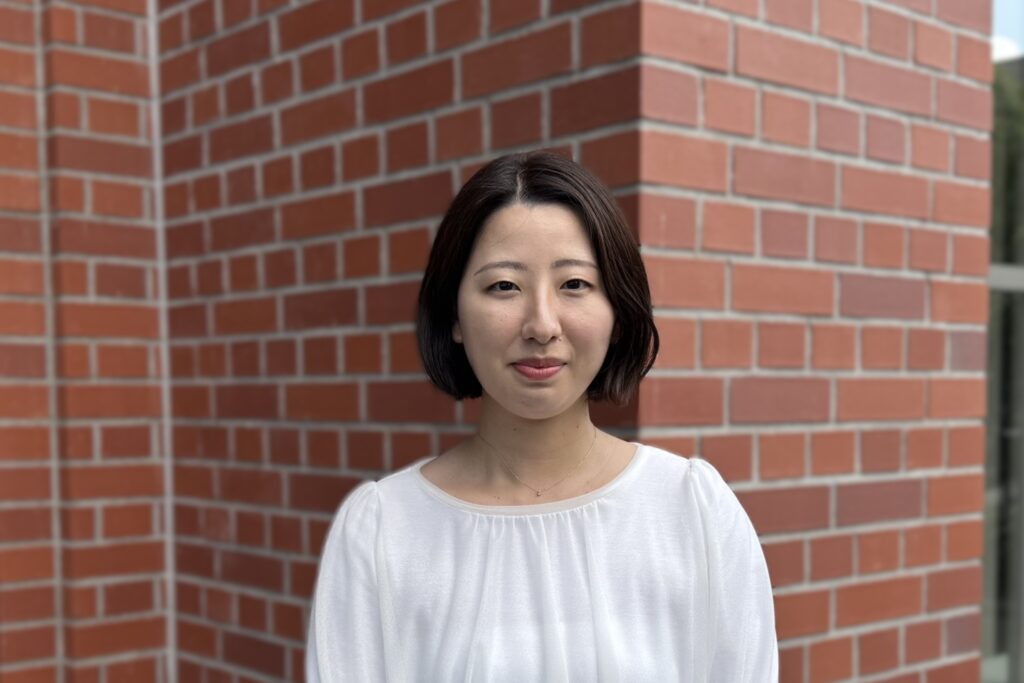
I want to carefully listen to the thoughts and wishes of patients before their dementia progresses, and provide nursing care that respects their values until the end. Mai Ogawa, who works as a nurse at a nursing home while also enrolled in a doctoral program at the Kyoto University Graduate School of Medicine, is working on the "development of an advance care planning (ACP) program for elderly people with mild dementia." We spoke to her about the issues she saw from her experience working at a university hospital, which inspired her to start this research, and about the research project she has just launched.
I want to incorporate patients' opinions into decision-making.
After graduating from university, I went on to a master's program at graduate school and conducted research in geriatric nursing, then got a job at a university hospital. I am currently working as a nurse at a nursing home while also enrolled in a doctoral program.
I worked in the geriatric medicine department at a university hospital for four years. I encountered many dementia patients, and many of those admitted had advanced symptoms, so I often felt the dilemma of "I want to hear what the patient is thinking, but there is no way to do so." In such cases, family members and medical professionals have to guess what the patient is thinking and make decisions about treatment and other matters.
Depending on the treatment chosen, it may be necessary to use a gastrostomy tube or a ventilator, which can cause pain and suffering to the patient. If it is not clear whether the patient "does not want aggressive treatment in the final stages" or "wants to keep the patient alive as long as possible," it places a heavy burden on those around them to make difficult decisions, and above all, it is impossible to be sure that it is in the patient's best interest. This is why I felt it was important to listen to the patient's words and thoughts and use them to make a decision before the symptoms progressed.
That's why we turned our attention to ACP. ACP involves individuals considering their current health condition, their future lifestyle, and the medical and care they would like to receive in the future, with support from a trusted medical and care team as needed, and discussing future plans with their families. Recently, the Ministry of Health, Labor and Welfare has been promoting this through an initiative called "Life Conferences" (*1), but it has not yet become widespread in Japan, and there is variation in how it is carried out and the support provided depending on the hospital or facility. This is particularly difficult when focusing on dementia.
One of the reasons for the difficulty is that ordinary language can be difficult to understand for people with dementia, and medical issues must also be discussed. Time constraints are also significant, as repeated interventions must be made while monitoring the individual's condition.
Furthermore, in countries such as the United States, where ACP is relatively widespread and emphasis is placed on the individual's independent decision-making, the value of "making your own decisions" is mainstream, but in East Asia, including Japan, where harmony with family and those around you is valued, many people tend to "put their family's wishes before their own." Taking into account the characteristics of dementia, a decision-making system is needed that provides maximum support to enable the individual to remain independent, while confirming their values and wishes in their own words and appropriately involving their family.
(*1)Why not try a "life conference"? | Ministry of Health, Labor and Welfare
Early intervention is needed
In the early stages, people with dementia may have clear willpower, but at other times their will wavers. As they become unable to do simple tasks like getting dressed, or become unsure of themselves, many lose confidence, suffer from low self-esteem, and experience distress.
The progression of dementia can take as long as 10 or 20 years, so both the patient and their family tend to put off discussing the issue, thinking, "Maybe it'll be a little longer." It is not uncommon for the patient to notice the condition by the time they notice it, as their cognitive function has declined and they are no longer able to understand their own thoughts and feelings. This is why it is so important to intervene at an early stage.
At the elderly care facility where I currently work, we regularly hold opportunities for residents to reflect on their lives and discuss topics such as "what they have valued in life." However, residents' conditions change over time, and they may be transferred from the facility to a hospital. This is why I want to create a system that allows residents' values and hopes to be shared and passed on even if their condition or location changes. By developing an ACP program specifically for dementia, I want to show that "even people with dementia have opportunities to communicate their thoughts and move forward."

What I can do as a researcher who knows the field
In the United States, the legal system has been improved, and in some cases, the implementation of ACP directly leads to the creation of a legally binding advance directive (a document in which a person writes down in advance what kind of medical care they would like to receive if they were to lose their will in the future). On the other hand, in Japan, the same legal binding force is not present, so it is difficult to see the significance of "what difference ACP will make," and it is difficult to spread the practice.
Although there is not yet much research overseas on implementing ACP for people with dementia, positive reactions have been reported, such as increased willingness to make decisions, satisfaction with participating in ACP, and reduced anxiety about future care (*2).
In Japan, there are few ACP support measures specific to dementia, so we will develop a program that is tailored to Japan's cultural background and social system while taking into account knowledge from overseas.We will then conduct a preliminary survey (pilot test) to confirm whether the program can be accepted (acceptability), whether it can be implemented in the field (feasibility), and whether the key points of the program have been implemented (fidelity).
When I worked as a nurse at a university hospital, I felt frustrated because I wanted to hear what the patient was thinking, but I didn't know how to do it. If there was a template that anyone could use in a time-pressed setting, it would reduce the anxiety of families and the hesitation of medical professionals, and above all, it would protect the patient's dignity.
As a researcher, I would like to objectively observe clinical settings, take the time to consider effective tools and intervention methods, and play a role in leading to their implementation. Ultimately, I would like to make the templates and checklists publicly available, creating a system that can be used in all care settings, including facilities, at home, and outpatient clinics.
(*2) See the following literature:
1. Tetrault, A., Nyback, M.-H., Vaartio-Rajalin, H., & Fagerström, L. (2022). Advance care planning in dementia care: Wants, beliefs, and insight. Nursing Ethics, 29(3), 696–708.
2. Ingravallo, F., Mignani, V., Mariani, E., Ottoboni, G., Melon, MC, & Chattat, R. (2018). Discussing advance care planning: insights from older people living in nursing homes and from family members. International Psychogeriatrics, 30(4), 569–579.
3. Sævareid, TJL, Førde, R., Thoresen, L., Lillemoen, L., & Pedersen, R. (2018). Significance of advance care planning in nursing homes: views from patients with cognitive impairment, their next of kin, health personnel, and managers. Clinical Interventions in Aging, 13, 1649–1661.