Neurodiversity, or the idea of regarding the diversity of the brain and nerves as individuality, and utilizing it in society with mutual respect, is now the key to human capital management.Supporting people with developmental disabilities to demonstrate their abilities in the workplaceThe " project focuses on this concept and aims to enable people with developmental characteristics to play an active role in advanced, cutting-edge IT work, where there is a shortage of workers.
As part of the project, we held the "SMBC Kyoto Neurodiversity Seminar" in collaboration with the Kyoto Sales Department of Sumitomo Mitsui Banking Corporation on Tuesday, November 11, 2025.
The seminar was attended by a wide range of people, from management to human resources personnel, from many companies, mainly in the manufacturing and IT/telecommunications industries. The majority of participants were companies that were considering promoting neurodiversity, indicating growing interest in the industry.
In this article, we will report on the keynote speech and experimental experience program at the seminar.
Keynote speech: From business strategies to understanding individual characteristics
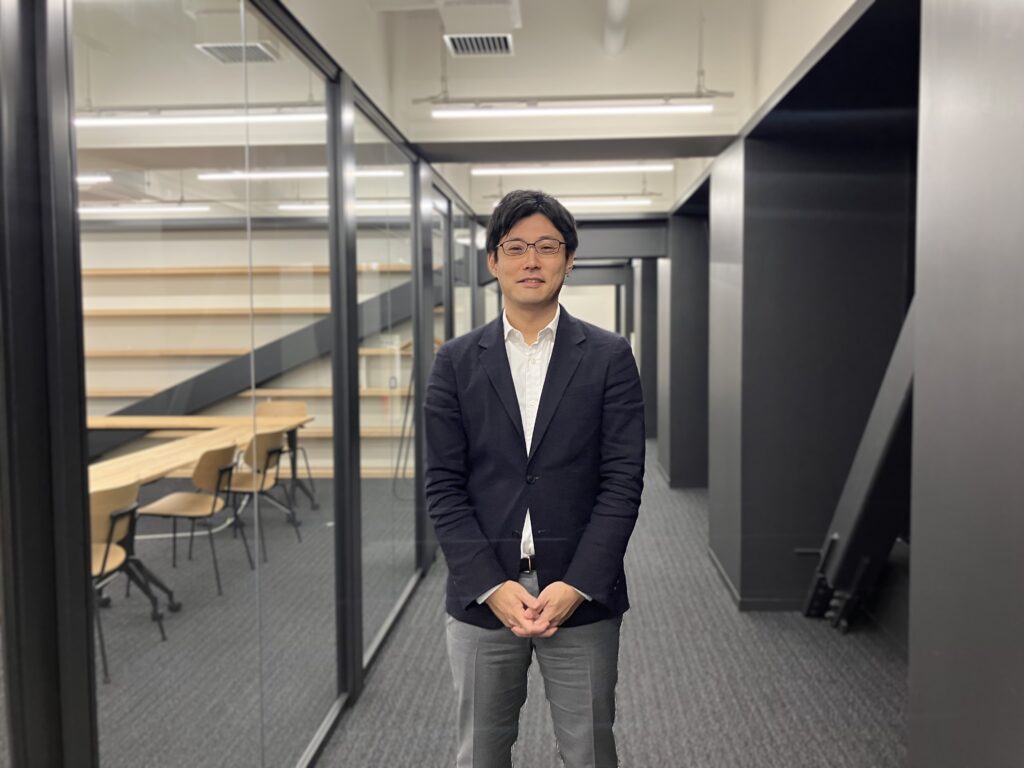
The lectures were given by project representative Tomoyuki Kimura (Center for Emergence Strategy, Japan Research Institute, Limited) and Professor Sayaka Yoshimura (Associate Professor, Graduate School of Medicine, Kyoto University). First, Researcher Kimura explained the current situation and necessity from a macro perspective of business strategy. Next, Professor Yoshimura focused on the micro cognitive characteristics of individuals, and the lectures were structured to encourage understanding of both theory and practice.
The importance of neurodiversity in management and the sharing of practical knowledge
The lecture was opened by the project's representative, Researcher Kimura of the Japan Research Institute. Kimura began by explaining from a macro perspective the current state of employment opportunities for people with developmental disabilities, which is his specialty. He pointed out that the mismatch between these people and the traditional work environment, which is based on typical development, is causing companies to be unable to utilize the advanced potential of these people.
In this era of accelerating innovation, he emphasized that in order for companies to gain a competitive advantage, it is essential to shift to "neurodiversity management," which views this unused human capital as a strategic asset. He also introduced the example of an IT work experience program run by the Neurodiversity Management Study Group.
Exploring the potential of neurodivergent talent from the perspective of cognitive function
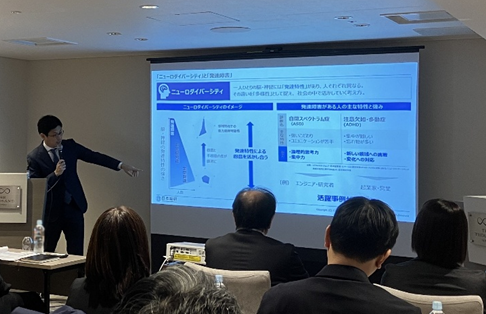
Next to speak was Professor Yoshimura of Kyoto University, who is also the project leader. He spoke about the necessity of strategy as outlined by Researcher Kimura, focusing on the individual characteristics that form the basis of it.
Professor Yoshimura presented the cognitive characteristics of neurodevelopmental disorders such as autism spectrum disorder (ASD) and attention-deficit hyperactivity disorder (ADHD) from the perspective of the diversity of information processing in the brain. He provided a clear answer based on medical knowledge to the question, "Why are some people able to demonstrate extraordinary abilities in specific tasks?"
It was suggested that traits of Autism Spectrum Disorder (ASD), such as a tendency to focus on specific parts without being distracted by the big picture, a tolerance for repetitive tasks, and a tendency to pursue particular interests, could lead to outstanding abilities as "specialists" in advanced IT fields such as data analysis, security, and atypical problem solving. Furthermore, traits of Attention Deficit Hyperactivity Disorder (ADHD), such as the ability to break through, disruptive innovation, and a unique sense of time, suggest potential for "innovative talent" who can create new value in today's rapidly changing world.
Experimental experience: Experience the possibilities of demonstrating your abilities
A major feature of this seminar was that it was not just a matter of sharing knowledge, but also provided participants with a forum for obtaining evidence regarding the exercise of their abilities, which was part of a collaborative research project.
We provided a unique testing environment designed for advanced, cutting-edge IT work, where individuals with developmental characteristics (especially ASD) are thought to be more likely to demonstrate their abilities. By experiencing the test, participants were able to get a firsthand feel for the potential for specific cognitive characteristics to produce extremely high output in specific work areas.

Summary: A message from the project representative
This seminar was a valuable opportunity to deepen understanding of neurodiversity management by experiencing the cutting edge of theory, practice, and research.
Professor Yoshimura, Kyoto University
"Knowing cognitive characteristics leads to understanding the behavior of individuals. I hope that this knowledge and perspective can be utilized in management that brings out the strengths of each individual."
Japan Research Institute Researcher Kimura
"It is essential to have a deep understanding of the characteristics of the parties involved and strengthen management to make the most of that understanding. In an age where the importance of innovation is being emphasized, why not start this initiative now?"
Closing remarks from the secretariat
At SMBC Kyoto University Studio, we will continue to conduct research and disseminate information to promote neurodiversity, and we hope to work with companies and organizations to shape these efforts. If you are interested, please contact us. Let's create a new future together.