"Support for sustainable decision-making and arrangements that preserve dignity for everyone during and after lifeThe " project aims to create a movement in which people think about and discuss the issue of self-determination as something that concerns them personally.
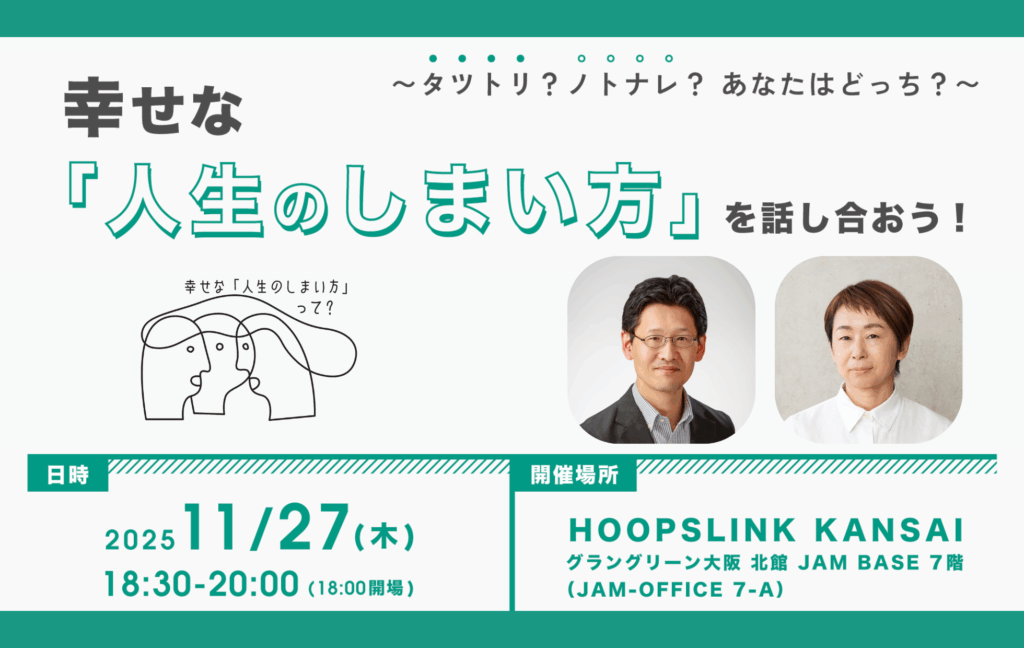
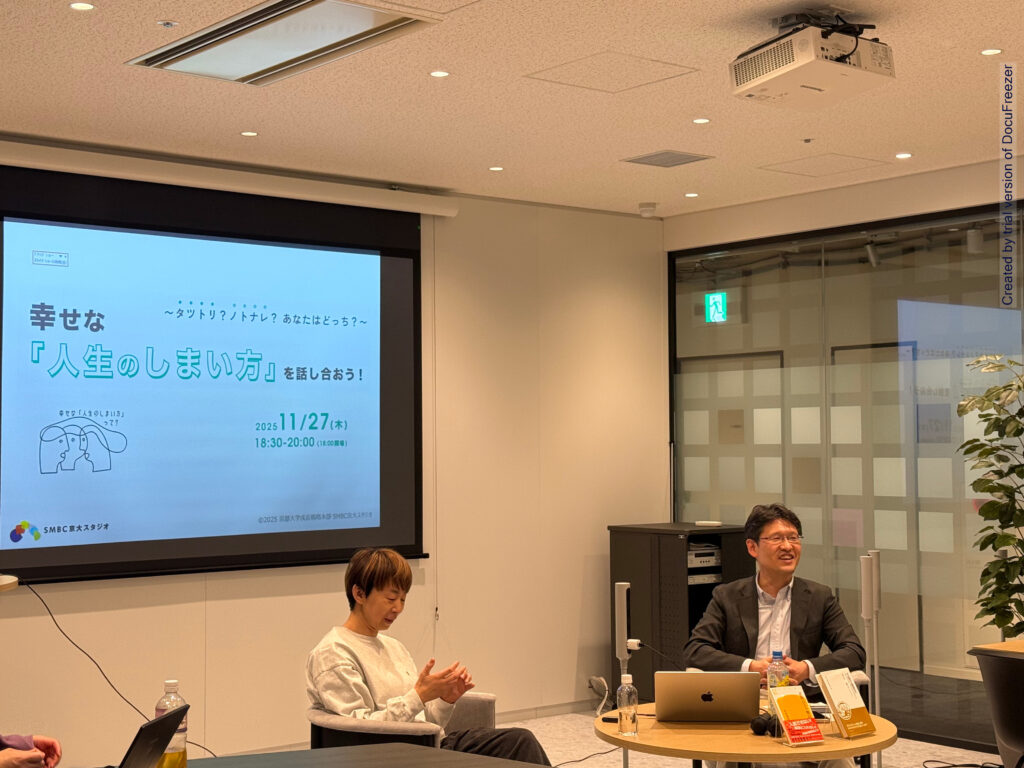
As part of the project, a dialogue session titled "Let's discuss how to end your life happily! - Tatsutori? Notonare? Which one are you?" was held at HOOPSLINK KANSAI on Thursday, November 27, 2025.
The event was attended by people of a wide range of ages, from teenagers to those in their 60s, and they discussed how to end their lives, taking inspiration from two types of endings: "Tatsutori" and "Notonare."
In this article, we will share information from experts at the event and details of the group discussions.
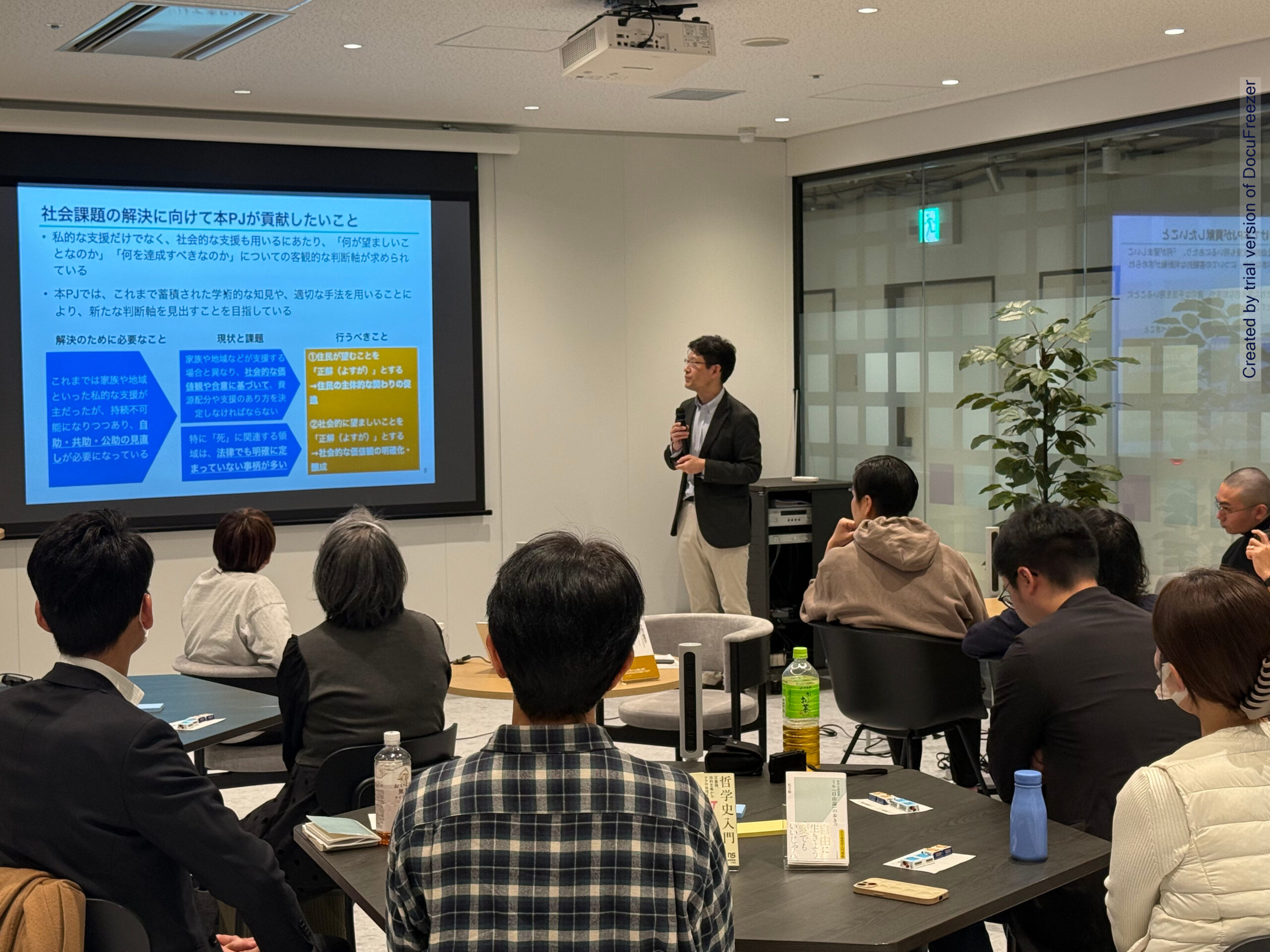
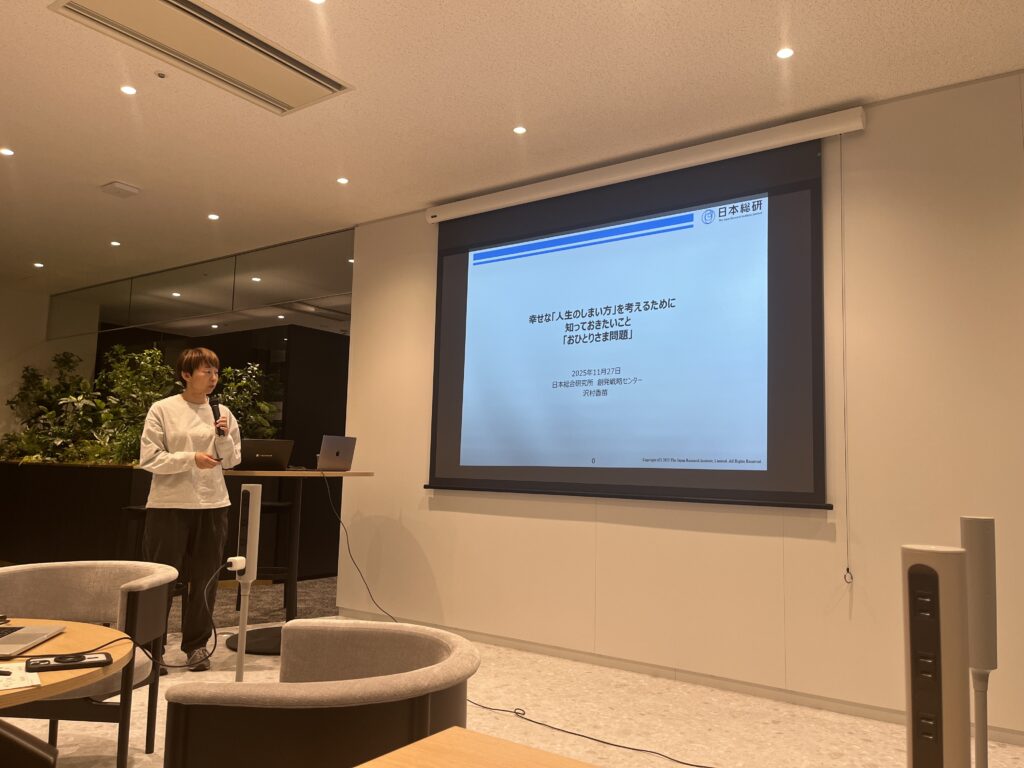
Source 1: What you need to know to think about how to end your life happily: "The problem of living alone" (Japan Research Institute/Kaname Sawamura)
As the first information presentation, Researcher Sawamura gave an overview of the difficulties individuals face from old age to after death, focusing on the theme of "the problem of living alone."
In modern society, as households shrink and people live longer, family functions are weakening. As a result, even if people have families, they are often unable to look after them in their old age. If one person experiences a change, even in a multi-person household, everyone can end up living alone.
He also introduced examples of how the increasing number of options for medical and nursing care services has actually increased the burden of choosing them, and how the shift from landlines to personal smartphones for contact has made it extremely time-consuming for third parties to contact relatives. Researcher Sawamura pointed out that in the past, family members who were close by would take care of all the big and small errands in life. He sounded the alarm about the current situation, in which everyone is at risk of becoming "alone" with no one to rely on, yet is troubled because they don't know what to do.
Information source 2: What is a happy way to end your life? Research introduction (Kyoto University/Kodama Satoshi)
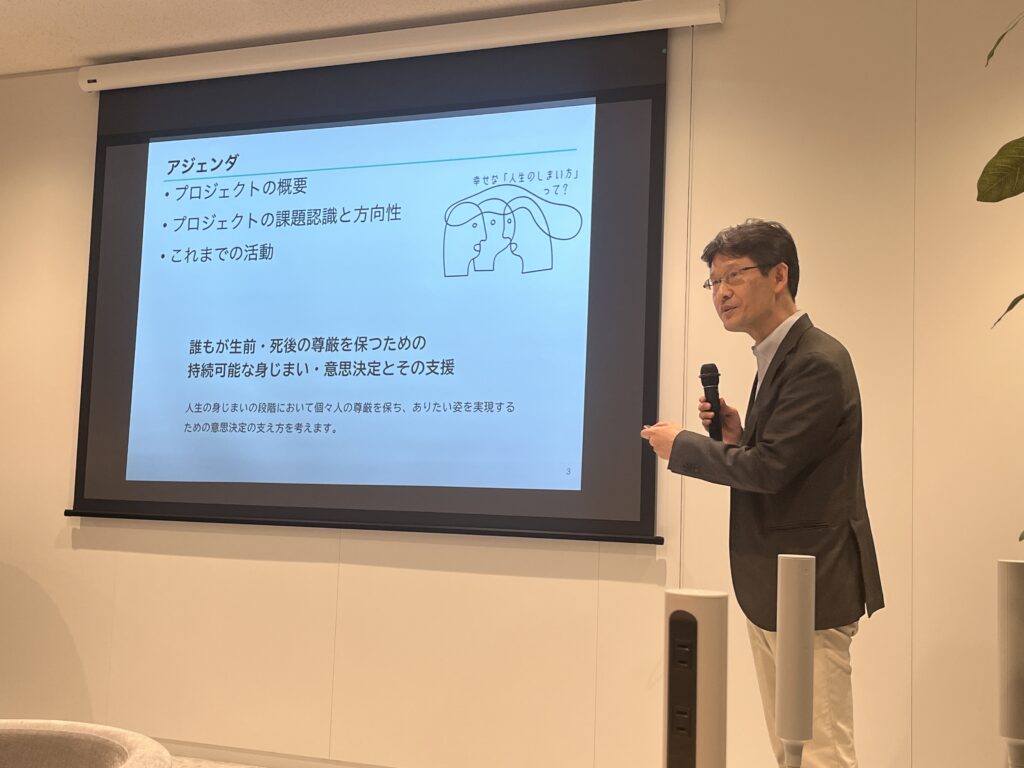
Next, Professor Kodama introduced the project, which aims to "consider ways to support decision-making that maintains the dignity of individuals at the stage of their lives and helps them realize their aspirations."
Professor Kodama spoke about what he has learned from previous dialogue sessions: that values regarding the use of services that provide support in old age and after death differ depending on occupation, age, experience, etc. In light of the current situation in which many people tend to put off planning for the end of their lives and the end of their lives in old age, he presented two types of "Tatsutori" and "Notonare" as tools to visualize feelings and actions toward the end of life, so that people can think of it as something that concerns them personally. "Tatsutori" refers to people who tend to "leave no trace behind" and "Notonare" refers to people who tend to "let the rest be what it may" (for details of each, seeHere(See the article.)
A dialogue about "how to end life" that transcends generations and positions
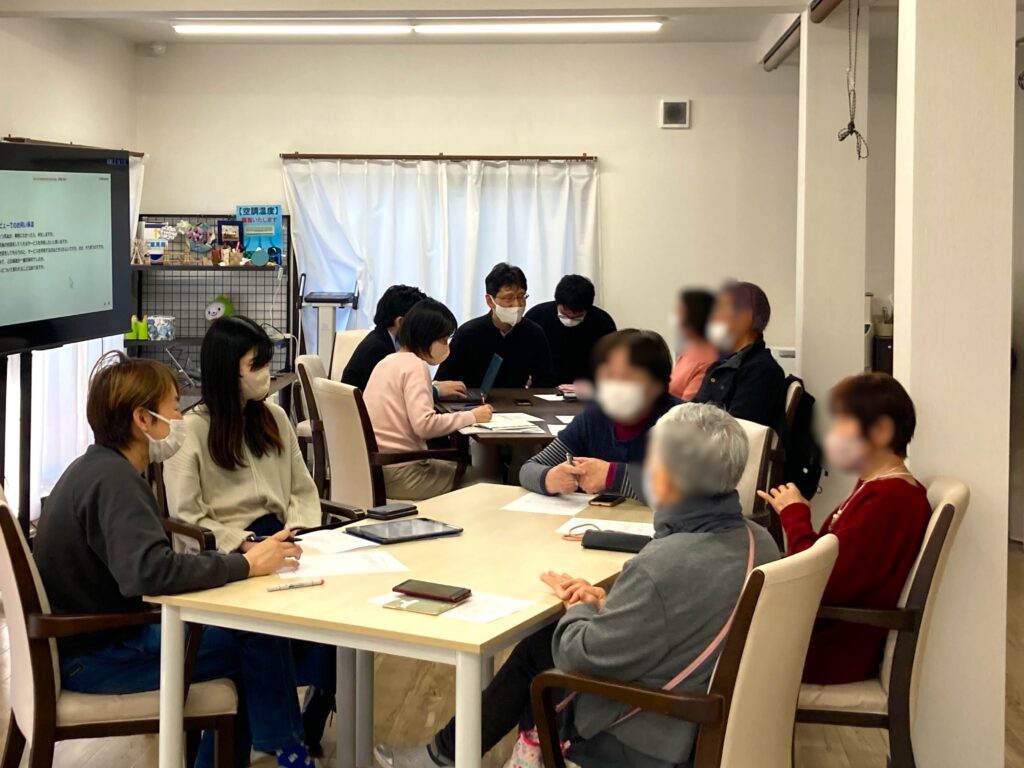
After providing the information, the group had a discussion based on the two types of "Tatsutori" and "Notonare." First, they were asked to think about whether they could categorize themselves as either a "Tatsutori" or a "Notonare" in terms of their feelings and their actual actions, and then they had a lively exchange of opinions based on that categorization.
The dialogue revealed differences based on generation and experience. While the majority of people who are "tatsutori" want to prepare mentally, they are unable to put it into practice and have become "not nare" (not ready). On the other hand, some people are "not nare" emotionally, but have become "tatsutori" due to pressure from those around them. This was a contemporary situation that was shared. One participant also shared the story of a parent who was a "tatsutori" and whose own experience of closing their home led them to become a "tatsutori" (not ready). Furthermore, one participant said that visiting a grave had prompted them to think about death, making this a valuable opportunity to seriously consider "how to close one's life" beyond differences in age and position.
Participants also commented that "it gives you an opportunity to talk with strangers and family," and "dividing it into two categories, Notonare and Tatsutori, gives you an opportunity to talk casually."
Summary and a message from the project leader
This event was the first dialogue to use "Tatsutori" and "Notonare." It was a valuable opportunity to recognize that the risk of "living alone" is a familiar issue for everyone, and that the classifications of "Tatsutori" and "Notonare" are effective in thinking about self-care.
Kyoto University/Kodama聡
This time, the dialogue was divided into two categories: "Tatsutori" and "Notonare." However, even when considering only emotional aspects, people are not completely either 0 or 1, as there are people who are "Tatsunoto" (Tatsutori + Notonare). This dialogue made me realize once again that while it is important to "prepare" for death, we should strive for a society that does not dismiss those who are unable to prepare in time as their own fault, and an inclusive society where generous "Notonare" people can live without being isolated, and I would like to continue exploring the shape of such a society in the future.
Japan Research Institute/SawamuraKanae
I felt that the words "tatsutori" and "notonare" were effective tools for discussing how we can tackle the issue of self-destruction as a society. I hope that we can continue to use opportunities like this to casually discuss self-destruction and death and create a new image of life.
Message from the Secretariat
Thank you very much to everyone who participated in this event. There is no single correct answer for how to end your life happily. This project aims to use this classification as a starting point to spread a movement throughout society in which each individual thinks specifically about and discusses the "tidying up of one's life," something that tends to be put off, based on their own situation and values.