"Support for sustainable decision-making and arrangements that preserve dignity for everyone during and after lifeThe catchphrase for this project is "What is the best way to end your life happily?"HereIn this article, we invited copywriter Tomo Harada, who created the catchphrase, to talk with the two project representatives about the background and thoughts behind the creation of the catchphrase. In this article, we will be sharing a conversation about the words "Tatsutori" and "Notonare," which were born out of a conversation with Harada.
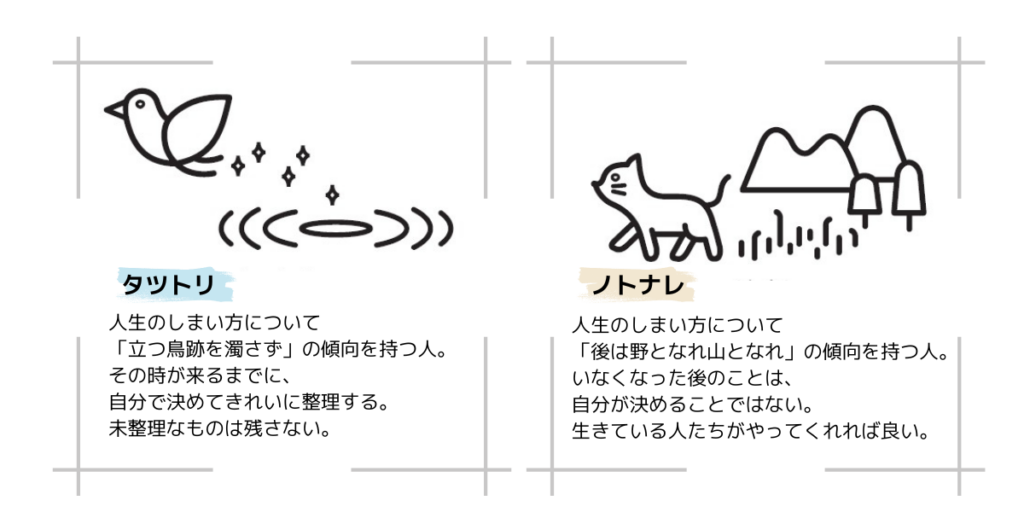
- In creating the catchphrase, Mr. Harada also came up with another phrase that served as a hook for discussion: "Tatsutori" and "Notonare." I'd like to hear about the background to the creation of these phrases.

(Sawamura) At first, Professor Kodama suggested that the proverb "A bird on the wing leaves no trace" might be relevant to the project.
(Kodama) That's right. After I asked Harada-san for his cooperation, I was thinking that I had to come up with something myself, and then I remembered the proverb, "A bird on the wing leaves no trace." At first, I thought it might be good to give this project a nickname like "The Bird on the Wing Project." As I researched it, I came across antonyms such as "to throw sand on the ground with one's hind legs" and "let the rest be what is." As we shared the idea with the other members and discussed it, Sawamura-san commented that he thought the phrase "let the rest be what is what" was particularly interesting, as it is often heard among elderly people.
When I shared these exchanges with Harada-san via email, he suggested, "Wouldn't it be good to have something like Tatsutori or Notonare?" I thought that was a good idea, and in subsequent exchanges with Harada-san, we came to the conclusion that it might spark debate if we asked, "Are you a Tatsutori fan or a Notonare fan?"
- Tatsutori is a contraction of "A bird on the wing leaves no trace" and Notonare is a contraction of "The rest is up to the mountains and the fields."
(Kodama) Yes. On the SMBC Kyoto University Studio project page, we write that there is still insufficient discussion about decision-making during and after life, and that in order to have such discussions, it is necessary to verbalize values. I think that Tatsutori and Notonare are perfect examples of putting values into words. By putting them into words in this way, we can start thinking about what kind of fate we want for ourselves.
(Sawamura) There are proverbs like "A bird that flies away leaves no trace" and "Let the rest be what is, let it be what is" as ways of ending things, so I think that these have been common since ancient times. When I think about how there are often times in our daily lives when we want to use these phrases, both "tatsutori" and "notonare" are also possible when it comes to ending things.
(Harada) The other day, I was reading an interview article and I thought, "This person has a tendency to be lazy." The person said that he has collected a lot of things as a hobby, but that when he dies, he wants his family to do with them as they please. He said that he felt that it would be selfish of him to ask his family to decide how to dispose of them, such as by saying, "I want you to donate this place." I thought that the fact that the interviewer was asking such a story was a sign that society is becoming more interested in how we end our lives.
(Kodama) I think there are various patterns for Notonare. As in the case of the current story, there are people who leave it to their trustworthy family, but there are also people who really want to prepare for the end of their life but can't because they don't have the time or money. Many people may think that they have to become a Tatsutori - in other words, they have to be properly prepared - but I think there are also desirable ways for Notonare to be. People who want to become a Tatsutori should be helped to become one, and for people who are fine with Notonare, I think it's fine for them to use Notonare.
(Sawamura) Some people believe that it would be better if people could become wild or mountainous without having to do everything themselves, with the support of those around them, and that such a society would be richer. Many people around me in the welfare field hold this view. Even if someone doesn't have family to rely on, I think that wanting to live in a society where those around them can do something to help them is one correct answer. However, in today's society, there is an issue where people who want to become Notonare cannot actually become wild or mountainous.
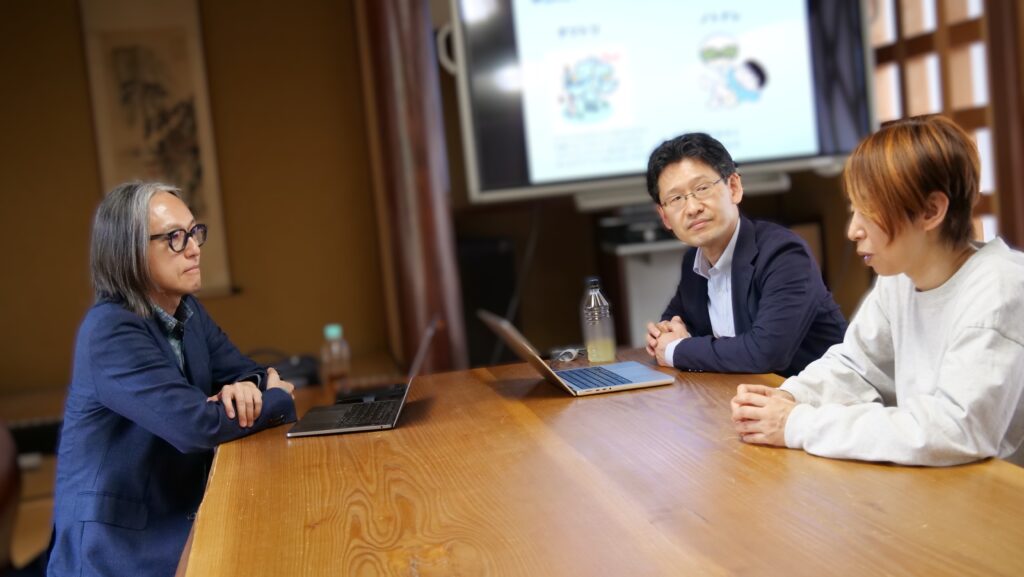
-The words "tatsutori" and "notonare" have started to come up naturally in conversation.
(Harada) I received an email from Mr. Kodama, and when I wrote the four katakana characters "Tatsutori" and "Notonare," it somehow gave the characters a sense of character. I think that was a good idea.
(Kodama) Project members have already shortened these discussions to "Tatsunoto." We would like to spread this term as a starting point for discussion.
The conversation between the three of them that followed is now available on YouTube. If you're interested, please take a look here.
・Communication that begins with dualism
・What is happiness in modern society?
・How to deal with the end of life
・When you can't make a decision, you and the people around you