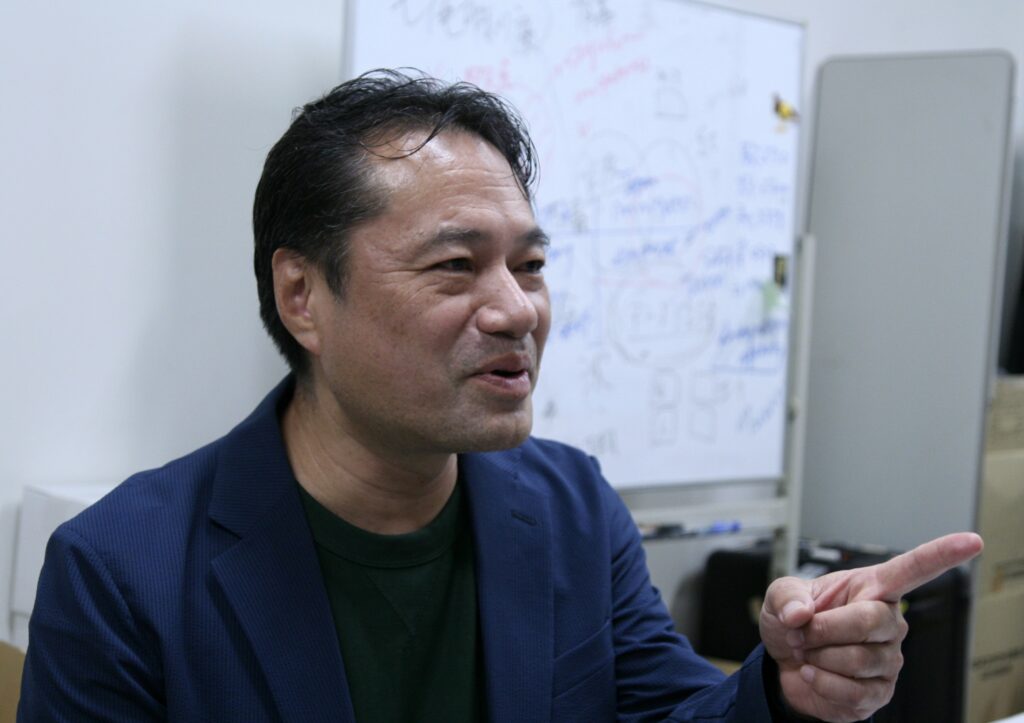
As Japan's population continues to decline due to a declining birthrate and aging population, people from overseas are playing a major role in the workforce in places close to us. It is no longer uncommon to see people from various countries at convenience stores and construction sites. But has the system for accepting foreign workers been put in place? We spoke to Professor Kazuaki Asato of the Graduate School of Letters at Kyoto University, who leads the project "Systems for Sending and Accepting Overseas Human Resources and Non-Regular Work: Social Costs and Institutional Challenges."
Why are non-regular workers created?
Japan is entering a society with a declining population, and how to maintain society is a major issue. It is clear that we cannot maintain society unless everyone supports each other, but what is the current situation?
Due to economic needs, women have been gradually entering the workforce. However, it seems that there are headwinds when it comes to the inclusion of people from overseas. In 2025, the Immigration Services Agency of Japan announced the "Zero Illegal Residents Plan for the Safety and Security of the People" as a response to "growing anxiety among the public due to reports of foreigners not following the rules."
Despite the need for more people to play an active role in a time of declining population, I am aware of the issue that there may actually be movements that hinder this. Why do foreigners in what is known as "non-regular" employment emerge in Japanese society? Behind this lies a problem with the system itself. In this project, I would like to focus on foreigners known as "non-regular residents" and shed light on the social structure that has given rise to non-regular employment.
Is the strictness of the framework legally creating "illegals"?
As of 2024, Vietnamese people rank first in the number of illegal overstayers, the number of foreign technical intern trainees who have disappeared, and the number of people arrested for criminal offenses (*1). Many people have probably come across reports such as "Vietnamese people who came to Japan as technical intern trainees were arrested in connection with an anonymous, mobile criminal group (Tokuryu)." Of course, this is only a small number of cases, and it goes without saying that many technical intern trainees work honestly, but like young people and those in unstable employment, foreign workers are vulnerable to being targeted as perpetrators or accomplices to crimes.
So why did this situation come about?
It is common for Vietnamese people coming to Japan under the Technical Intern Training Program to have large debts due to placement fees to dispatching agencies and payments to intermediaries. There are many cases where Vietnamese people come to Japan in debt, hearing that they can earn a high salary, only to end up not earning as much as they expected and being forced to work in harsh conditions. In one case I was involved in, a technical intern working at a construction site in Aomori was forced to work at heights without safety equipment in the winter, even though the scaffolding was frozen, and was subjected to verbal abuse from the Japanese host.
However, technical intern trainees are not permitted to change jobs in principle, so they have no choice but to endure and continue working. If they change jobs, even if it is actually a "job change," they will be considered a "missing person" or "suspect" under the Immigration Control Act.
In this way, I think that the framework of the system surrounding foreign technical intern trainees is so strict that it naturally produces people who are forced into irregular stays. Rather than attributing the causes of these problems solely to individuals, perhaps we can also see them as problems with the underlying structure.
In fact, the pass rate for the national care worker exam for Vietnamese who come to Japan under the Economic Partnership Agreement (EPA) rather than the Technical Intern Training Program is about 90%. This is a higher pass rate than that of Japanese test takers (*2). By using the EPA, they can come to Japan without debt, having studied Japanese thoroughly with government support. There are almost no cases of Vietnamese who come to Japan under this good system disappearing, and it has received high praise from the receiving facilities.
(*1) The number of illegal overstayers is from the Ministry of Justice's "Number of Illegal Overstayers in Japan," the number of missing foreign technical intern trainees is from the Ministry of Justice's "Trends in the Number of Missing Technical Intern Trainees," and the number of people arrested for criminal offenses is from the National Police Agency's "The Situation of Organized Crime."
(*2) According to the Ministry of Health, Labor and Welfare's "Announcement of the Results of the National Examination for Certified Care Workers," the pass rate for 2024 was 88.8% for Vietnamese test takers and 78.3% for Japanese test takers.
Is the system capable of contributing to "human resource development"?
Looking at the average amount of initial expenses paid before arriving in Japan for absconding technical intern trainees, the average was approximately 1.02 million yen for Vietnamese trainees, compared to approximately 220,000 yen for Filipino trainees (*3). Behind this difference is a systemic feature in which the Philippine government does not permit the collection of recruitment fees from technical intern trainees. Just as Japan does not pay recruitment fees when job-seeking, it is not permitted to collect money from job seekers. This is also stipulated in an international treaty of the International Labor Organization (ILO) (*4), but many sending countries have not ratified this treaty, and some countries allow the collection of high recruitment fees. In this sense, many sending countries take the irregular approach of requiring trainees to pay the recruitment fees themselves.
Furthermore, technical intern trainees who rely on brokers to come to Japan tend to incur higher initial costs. For Vietnamese, this reaches approximately 1.1 million yen, while for Filipinos, it is only about 120,000 yen. Despite the issue of high recruitment fees, Japan is increasingly accepting trainees from countries such as Vietnam, which charge high recruitment fees. This is because by having the trainees pay, there are benefits to accepting Japanese companies and organizations, such as not having to cover the cost of training, or not having to pay for transportation or meals when visiting the local area.
As the business environment surrounding Japanese small and medium-sized enterprises becomes increasingly severe, companies are increasingly being forced to deal with labor shortages by taking on debt to cover recruitment costs and relying on technical intern trainees who are willing to work for low wages. This is a realistic response for small and medium-sized enterprises that are under strong cost constraints.
On the other hand, a 2022 survey by the Ministry of Health, Labor and Welfare found that approximately 70% of companies employing technical intern trainees have violated the Labor Standards Act in some way, such as nonpayment of wages or violations of safety and health regulations. As a result, it has become clear that the working environment and safety of technical intern trainees who came to Japan hoping to work there are not being adequately protected.
Going forward, rather than relying on low-cost labor, how to create jobs that utilize the capabilities of workers and increase productivity and added value will be an important issue from the perspective of both the sustainability of small and medium-sized enterprises and the stability of society as a whole. While some companies are trying to encourage trainees to stay and increase productivity by improving their working conditions, the reality is that some companies cannot afford to do so. Although the Technical Intern Training Program was originally established with the aim of contributing to "human resource development," in reality this is not always the case, and labor exploitation is even occurring. Furthermore, as more people try to escape harsh environments, social costs such as maintaining public safety increase.
In this research, I will analyze the causes of "non-regularization" through interviews with people who came to Japan to work and then were repatriated to Vietnam or the Philippines, as well as with people working in Japan's nursing care and agricultural sectors. In order to create an inclusive and sustainable Japanese society, it is essential to create systems and an environment that allow everyone to participate in society, regardless of nationality, gender, age, disability, or other social identities. In an era of declining birthrates and a declining population, what is needed is a society designed on the premise of inclusion rather than exclusion. I would like to propose improvements on what kind of social policies should be adopted in the future.
(*3) <Article> International Labor Market and Rising Recruitment Fees: The Failure of Price Control in the Technical Intern Training Program (Kyoto Annual Report of Sociology (30), 1-25, December 2022)
(*4) Convention concerning Private Employment Agencies (ILO No. 181)