On November 28th and 29th, 2025, the Social Creative Research Institute run by Musashino Art University and the Japan Research Institute held "Ichigaya Innovation Days 2025 - Participatory Future".Research, development and dissemination of educational approaches that overcome the cycle of poverty, inequality and abuseMembers of the " " project took to the stage to discuss the research being conducted at the SMBC Kyoto University Studio, entitled "The Light and Shadow of Co-creation in Schools - Accompanying, Co-creation, and Beyond." Project representative Naoki Yamamoto, a researcher at the Japan Research Institute, will report on the key points of the discussion and the implications that were gained.
Abstract
As we enter the 21st century, schools are opening up to the outside world, and collaboration with external organizations is becoming increasingly important. However, this has not always been easy to achieve, with gaps in perception due to cultural differences and institutional barriers. How should schools and companies with different cultures cooperate and co-create? At the seminar, we discussed methods for collaborating with organizations with different cultures, the concept of collective impact, and the differences and relationships between "accompanying" and "co-creation" with Yumiko Takaishi, a service designer and art director at Concent Inc., which works at the intersection of education and business, and Masako Senaha, a researcher at the Japan Research Institute.
In more detail, the main points of the discussion on the day are summarized below in three points.
1. Deepening collective impact and "ownership"
"Collective impact," a concept of collaboration between different sectors, was introduced by John Kania and Mark Kramer in the Stanford Social Innovation Review in 2011. It outlines the conditions and processes for effective, long-term collaboration between different sectors, and has had a major impact around the world. The following five conditions are key for collective impact:
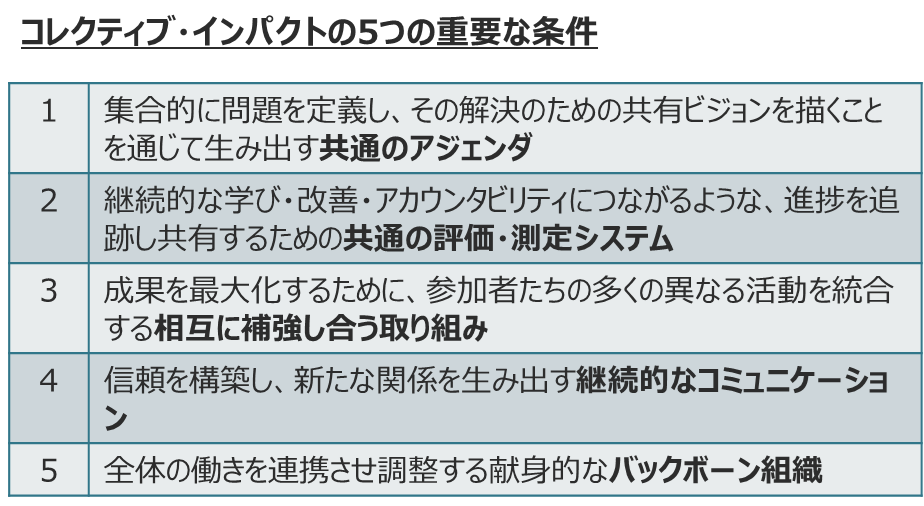
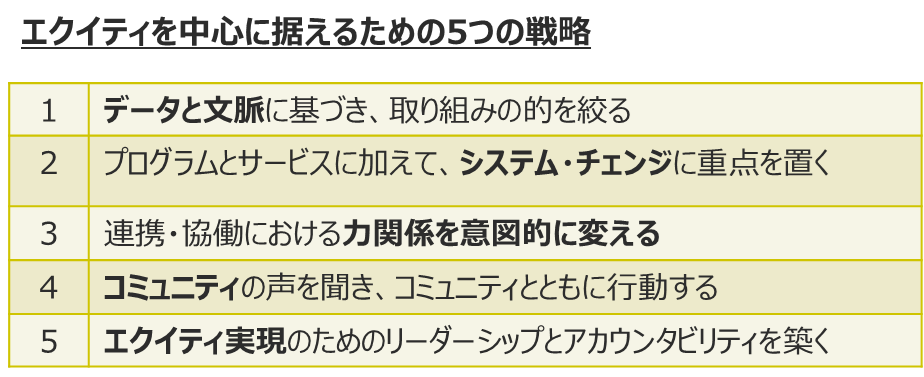
Then, in 2022, the traditional concept of Collective Impact underwent a major revision. A new definition was added after looking back at previous efforts and reflecting on what had not worked. The key words are "improving equity" and "community voice." The new definition of Collective Impact places these at the heart of the initiative, and instead of pushing forward with the right answers decided by supporters, it has shifted its focus to working with the people who are the main players in the issues and bringing about real change.
2. The difference between supporting schools and co-creating
Co-creation between schools and companies is on the rise. However, necessary dialogue before co-creation often lacks. Schools are busy and lack understanding of the circumstances of non-school organizations, such as companies, making it difficult to provide appropriate direction to external collaborators. Often, situations arise where the outsiders are left to their own devices, or the intentions of the lessons they are trying to deliver are not fully communicated, leading to conflicts once the curriculum has progressed to a certain extent. Furthermore, while it would be ideal for schools and companies to interact on an equal footing as professionals, there is a limit to the amount of compensation that schools can pay, creating a structure that easily leads to resentment and dissatisfaction on both sides.
One way to overcome this was to consider an approach where, rather than simply taking on the responsibility of teaching classes or lectures when engaging with schools from the outside, and not simply becoming the implementers of a curriculum brought in from the outside, teachers would be supported in the "joy of creating lessons" and in designing the curriculum. The difference between supporting and co-creating was discussed. The three speakers interpreted each of these concepts as follows:
Accompanying:By drawing out the other person's "true desires" like an editor and staying close to them for a certain period of time,Able to move independentlyTo aim for this.
co-creation: A flat relationship where each party brings out their strengths and actively works towards a common goal (flag).
It has become clear that by using these two appropriately, there is sometimes a hybrid form known as "accompanying for co-creation."
3. The need for "soft people" who can transcend cultural and organizational barriers
Even though schools and private companies use the same terms "contract work" and "output," their interpretations and timescales are very different. It goes without saying that the presence of a "translator" who can bridge this language and cultural gap is essential for smooth collaboration between organizations. However, true co-creation will not occur if translation and dialogue are based on organizational theories and titles. We believe that "smooth people" who put aside their organizational titles and gently speak about their personal interests and concerns will be the key to filling in the gaps within an organization and breaking down its walls.
After the presentation: Suggestions for the practice of "Education for Living"
Of particular note in the discussions at this seminar was the idea of translators as a slippery presence between different cultures. This presence may coincide with the character and qualities required of those in the role of accompaniment, which is currently being researched to spread "education for living."
When implementing "Education for Living" on a school-wide scale, teachers are required to co-create toward a common goal. When teachers interact with the children they work with, they often have different awareness of the issues, which can sometimes create barriers between them and other teachers. What is needed is a "soft person" who can dissolve these barriers and create true co-creation, and this is the role of a companion. Based on this discussion, we will now consider the ideal personality of a companion.