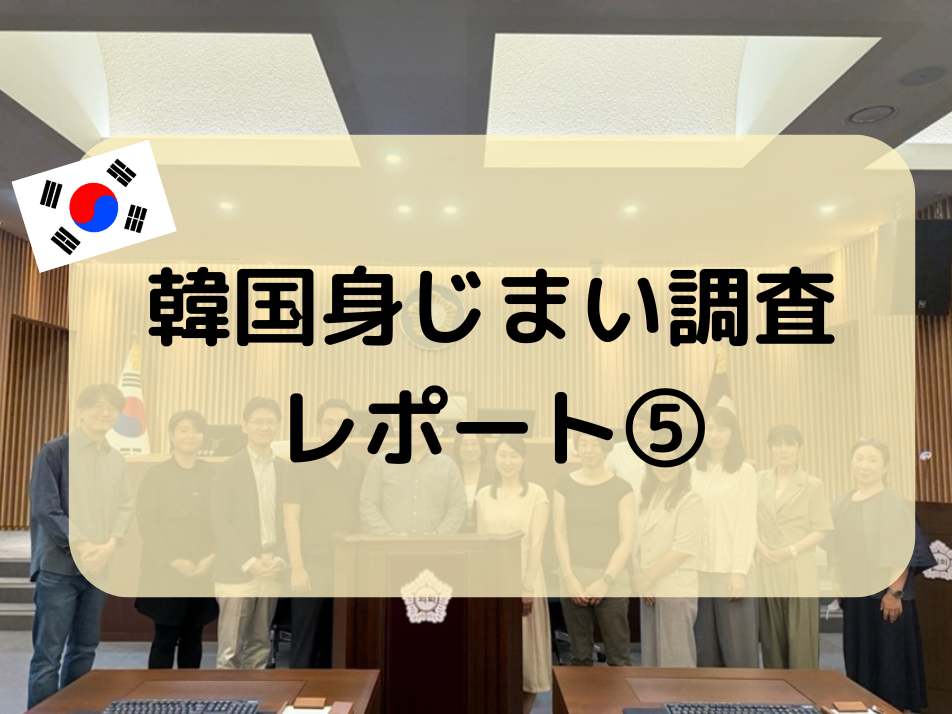
From August 8th to 12th, 2025,Support for sustainable decision-making and arrangements that preserve dignity for everyone during and after life" project, I visited Seoul, Korea to investigate decision-making support for the elderly. The outline of the investigation is as follows:HerePlease see the article.
Looking back on the entire survey, we asked project representative Professor Kodama and researcher Sawamura to talk about what they learned in Korea.
Korean law undergoes unique development
(Kodama) The proportion of South Korea's population aged 65 and over will be 20.3% as of 2024 (*1). In Japan, it is 29.3% (*1), so it can be said that Japan is more advanced in terms of aging. However, South Korea has been experiencing a rapid decline in its birthrate in recent years, and it is said that the proportion of the elderly population will rise sharply in the future.
South Korea has created policies and systems by taking inspiration from Japan, which has already experienced an aging population. For example, I heard that the Integrated Care Support Act was created based on Japan's community-based integrated care system.Report ⑤On the other hand, the law is more comprehensive than Japan's community-based integrated care system, and while it is conscious of Japan, it seems to have developed in its own way.
(Sawamura) Japan's community-based integrated care system was established in the revised Long-Term Care Insurance Act in 2011 with the aim of enabling elderly people to continue living in their familiar communities until the end by receiving medical and nursing care services as well as support for all aspects of daily life, such as housing, transportation, meals, and supervision. South Korea's Integrated Care Support Act is intended to cover a wide range of people, including not only the elderly but also people with disabilities and illnesses.
(Kodama) In terms of law, it is worth noting that Korea has a law regarding decision-making regarding end-of-life medical care called the Life-Sustaining Medical Care Decision-Making Act (Report 2(See reference). This law, which aims to improve hospice care and legalize the discontinuation of end-of-life medical treatment, requires the creation of an AD (Advance Directive) (*2). The ADs created are registered in an online database and can be viewed by any hospital. The number of registered ADs is increasing, and it is said that there are currently over 3 million.
(Sawamura) South Korea and Taiwan have laws that take death into consideration, but Japan does not have any laws, and only has guidelines and public awareness campaigns from the government and academic societies.
(Kodama) Yes. I think the law has had a major impact on the progress in registering ADs among citizens and the establishment of specialized facilities like the Palliative Care and Clinical Ethics Center at Seoul National University Hospital. On the other hand, I've heard that while many people in Korea have registered ADs, there are concerns that this is not a sufficient expression of their wishes. The AD requirements have been simplified, and the current requirement is only "whether or not hospice care is sought." Previously, there were several items, such as artificial respiration and dialysis, but the multiple items apparently caused confusion in the field.
(*1) Statistics Bureau, Ministry of Internal Affairs and CommunicationsStatistical Topics No. 146: Japan's Elderly from a Statistical Perspective - In Honor of Respect for the Aged Day"twist
(*2) Advance Directive (AD): Expressing your wishes in advance regarding medical procedures to be performed on you in the future when you lose the ability to make decisions. Also, this refers to the document (advance directive) for this purpose.
Family involvement in decision-making
(Kodama) In the context of end-of-life decision-making, I think that family members have a big influence in Korea. Dr. Yoon, a family physician, told me that family physicians do not just treat one patient, but the whole family as well.Report 3(See reference.) In the case of elderly patients, decisions may be made with consideration given to their families.
(Sawamura) I also heard that because of the close relationship with the family, financial aspects are also taken into consideration when choosing treatment. In Japan, for example, when the patient and their family make a decision about surgery, the main discussion is about how much the patient will improve if they undergo surgery, and they rarely discuss how much it will cost. In Korea, it seems that a choice cannot be made without considering the budget.
(Kodama) I think it's assumed that the family will pay for it. Incidentally, South Korea, like Japan, has a universal health insurance system, but it seems that there are a certain number of people who cannot pay the co-payment. If the elderly and their families cannot pay, it becomes difficult to receive long-term treatment and nursing care. Therefore, it seems that minimum treatment can be received at public health centers. Going back to the topic at hand, we've heard in many places that medical decision-making is in the hands of the family.
(Sawamura) I also spoke to financial institutions in Korea, and it seems that many people use services like testamentary trusts to eliminate family disputes. I also heard about cases where there were disputes over how to deal with cases where there were multiple children, but there wasn't much talk about people with no relatives, such as the so-called elderly who live alone, as in Japan.
(Kodama) Professor Yoon also mentioned elderly people living alone, but it didn't seem to be a big problem. In that respect, the situation may still be different from Japan.
The power of mutual assistance through community building
(Sawamura) One thing I noticed that was very different between Korea and Japan was the awareness of going outside the home. When I visited a Seoul Municipal Welfare Facility for the Elderly, I was surprised to see that the floor I visited was almost full.Report 4(See reference). At least in Japan, I have never seen so many people in elderly care facilities. It seems that when they build facilities or hold events, a lot of people gather, and it seems like there is a culture of "the more you do, the more people respond."
(Kodama) I heard that the Building Act, created in the 1970s, requires that when building an apartment complex, a building such as a Respect for the Aged Building must be built nearby. A Respect for the Aged Building is a space where elderly people can gather and chat. Perhaps the existence of such spaces has created a culture of gathering together. Support provided by the Integrated Care Act and the Building Act is what is known as "public assistance," but it also seems that "mutual assistance" is functioning well, for example, in Mapo Ward, private companies are also involved in promoting community building.Report ⑤reference).
(Sawamura) I also found the story about kimchi I heard from a district council member in Mapo very interesting. He said that not only is kimchi culturally important in Korea, but there is also a custom of making and sharing kimchi not only for one's own household but also for one's neighbors. Perhaps these connections are what create a culture of mutual assistance.
Looking ahead
(Sawamura) Overall, I got the impression that although the proportion of the elderly population in South Korea is rapidly increasing, many people still have families. Japan's community-based integrated care system was established with the concept of "living in familiar communities until the end," and efforts are underway in various regions. However, as the aging and population decline continues, people are currently facing the difficulty of spending their final days at home. South Korea has only just enacted the Integrated Care Support Act, so future developments will be closely watched.
(Kodama) The purpose of South Korea's Integrated Care Support Act is to realize the final moments that individuals desire. In terms of medical care, South Korea seems to be more advanced, with the Life-Sustaining Medical Decision-Making Act, but in terms of lifestyle, Japan seems to be more advanced, with its community-based comprehensive care system and home medical care system. South Korea's Integrated Care Support Act will come into effect in 2026, so I would like to see how well it is working again in a few years. At the pilot project stage, it seemed like public assistance in the form of the law and mutual assistance in the form of the community were well combined.
(Sawamura) I feel that in Korea, local governments and businesses are trying new things, and that the people are more willing to respond to them than in Japan. It seems that we will see some movements that are different from those in Japan, so I would like to keep an eye on them.